Calves might be a smaller muscle group, but when you learn how to build calf muscles the right way, they can transform your strength, performance, and overall leg shape. Instead of relying on endless random calf raises, you will get much better results by combining smart training, good form, and supportive nutrition.
Below, you will find a clear, practical guide to training your calves effectively, even if you feel like you have “stubborn” lower legs.
Understand your calf muscles
Before you start piling on reps, it helps to know what you are actually training. Your calves are not just one muscle. The two main ones you want to target are the gastrocnemius and the soleus.
The gastrocnemius is the larger, more visible muscle that gives your calves shape. It crosses both your ankle and your knee, which means it helps you point your toes (plantar flexion) and bend your knee. The soleus sits underneath the gastrocnemius. It does not cross the knee, but it plays a big role in stabilizing your ankle and helping you push off the ground.
You also have the tibialis anterior on the front of your shin. Training this muscle improves balance and can help prevent shin splints. When you understand how these muscles work together, you can choose exercises and angles that hit all of them instead of repeating the same move and hoping for the best.
Fuel your calves with the right foods
Calf workouts alone are not enough. To actually build calf muscle, your body needs protein and nutrients that support recovery and growth. Think of your training as the trigger and your nutrition as the building material.
Protein is your top priority. Eggs provide about 7 grams of high quality protein each and are often called the gold standard of protein because they contain all the essential amino acids your muscles need to repair and grow. Wild salmon gives you around 20 grams of protein per 100 grams plus omega 3 fatty acids that support overall muscle health and recovery. Spinach adds iron and nitrates, which help with cell metabolism and muscle growth, and it is an easy addition to omelets, smoothies, or stir fries. Chicken is another staple, with about 31 grams of protein and only about 4 grams of fat per 100 grams, which makes it a lean option when you are focused on building muscle without adding a lot of extra calories.
You do not need to overhaul your entire diet to support calf growth. Start by making sure each meal contains a source of quality protein, some colorful vegetables, and enough total calories to support your activity level. Over time, this consistent approach will help your calves, and the rest of your body, respond better to your training.
Get your form and range of motion right
If your calves have “never grown” despite years of walking and occasional calf raises, the problem is usually not your genetics. It is more likely that your muscles are not being challenged through a full range of motion with enough intensity.
Your ankle can move into dorsiflexion, where your toes come up toward your shin, by roughly 20 degrees, and plantar flexion, where you point your toes, by about 50 degrees. Effective calf work uses as much of that range as possible. That means lowering your heels below a raised surface, such as a step or block, then rising all the way up onto your toes for each rep.
Avoid bouncing at the bottom or rushing through the movement. Controlled reps with a brief pause at the hardest points keep the tension on the muscle instead of letting momentum do the work. This is especially important because your calves are used to low intensity tasks like walking several thousand steps a day. To convince them to grow, you have to give them something they are not already adapted to, which is longer ranges of motion and higher levels of tension.
Pick exercises that actually build calves
To build calf muscles, you want a mix of strength movements and plyometric work. Each plays a different role in how your calves look and feel.
Key strength exercises
Strength exercises let you apply heavy or high volume loads through a predictable movement. Solid options include:
- Standing calf raises
- Leg press calf raises
- Single leg calf raises
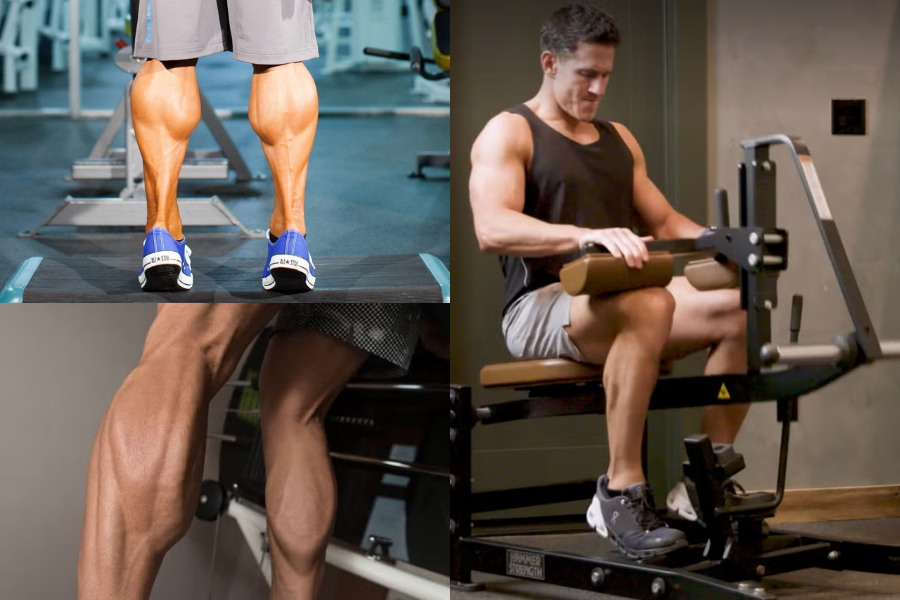
- Seated calf raises
- Eccentric calf raises (slow lowering phase)
Standing variations hit the gastrocnemius more because your knee stays relatively straight. Seated variations emphasize the soleus, since your knees are bent. This is important because training only one position usually leaves part of your calf underworked.
You can perform these with bodyweight, dumbbells, a barbell, or machines. Start with a load around 5 to 10 percent of your body weight if you are new, then increase by roughly 5 to 10 percent each week as long as your technique stays solid and you are not experiencing pain.
Add plyometrics for power
Plyometric exercises train your calves to be springy and powerful. They will not replace strength work, but they complement it and can improve definition and athleticism.
Simple options include lunge jumps and jump rope. Focus on pushing off through your toes and landing softly with control. These drills force your calves to contract quickly and absorb force, which challenges both the muscle fibers and the tendons.
Start with short sessions, for example 30 seconds of jump rope followed by 30 to 60 seconds of rest. Over time you can build volume, but keep the quality of your landings in mind to protect your joints.
Train both gastrocnemius and soleus
You will get the best results when you intentionally train both major calf muscles. A big part of this comes down to knee angle and exercise selection.
Research has shown that knee position changes which muscle does more of the work. Exercises with a straight or slightly bent knee, like standing calf raises, place more demand on the gastrocnemius, which contains more fast twitch fibers and responds well to heavier loads and moderate reps, around 8 to 12 per set. Movements with a bent knee, like seated calf raises or squatting calf raises, shift the emphasis to the soleus, which is made up of roughly 80 percent slow twitch fibers and responds better to higher reps, around 15 to 30 per set, and longer time under tension.
Foot angle matters too. Pointing your feet slightly outward will target the medial head of the gastrocnemius more, while pointing them slightly inward places more load on the lateral head. Keeping your feet straight shares the work between both. One useful approach is to rotate foot positions between sets so that over the course of a workout you have trained every part of the muscle.
Plan your sets, reps, and weekly routine
Calves often need more volume than you think, mostly because they are so used to everyday use. A basic structure for hypertrophy is 4 to 5 sets of 6 to 12 or more reps, performed at least twice per week, with 2 to 3 calf exercises per session.
Here is one way to organize your training:
One standing calf exercise, one seated calf exercise, and one single leg or eccentric variation, trained 2 to 3 times per week with a mix of rep ranges.
For example, your first calf day could focus on moderate reps and heavier weight for the gastrocnemius, and your second could use lighter weight and higher reps to challenge the soleus. A third optional session might include more plyometric work and tip toe farmer’s carries, where you walk slowly on your toes while holding weights at your sides.
Keep in mind that you do not need to chase extreme loads to grow your calves. A 2020 study by Brad Schoenfeld and colleagues found that high volume, lower load training taken close to failure was very effective for building muscle, which fits well with how calf muscles are built. The key is pushing each set with effort, not just going through the motions.
Use intensity and variation without losing control
Because your calves are a mix of slow and fast twitch fibers, they respond well to varied training. That might mean changing rep ranges, adding pauses, or trying different types of calf raises across the week.
You can use methods like:
- Rest pause sets, where you perform a set close to failure, rest briefly, then squeeze out a few more reps.
- Intermittent stretch overload, where you hold a deep calf stretch between sets to keep tension on the muscle.
- Partial reps at the end of a set, focusing on the top or bottom third of the movement once you cannot do full range reps.
What you want to avoid is sloppy technique. Bouncing or jerking at the bottom puts stress on your Achilles tendon and steals tension away from the muscle. Instead, use a controlled tempo, such as one to two seconds to lower, a slight pause at the bottom, then one second to rise and a pause at the top.
Stretch and recover for better growth
Stretching is not just about flexibility. For calves, it can also support growth and recovery. Fully stretching your calves between sets and after training helps maintain mobility, encourages a bigger muscle pump, and may help with fascia expansion, which is the connective tissue that surrounds your muscles.
Simple stretches like dropping your heel off a step or leaning into a wall calf stretch for 20 to 30 seconds can be enough. Aim to stretch both with a straight knee and with a bent knee so you hit the gastrocnemius and soleus.
Recovery also includes rest days and adequate sleep. Your calves work all day just holding you upright, so when you start adding focused training sessions, they will need time to adapt. Soreness is normal at first, but if you have sharp pain or persistent tightness that does not ease with rest, it is worth dialing back the volume and checking your form.
Work with your genetics, not against them
Genetics do influence calf size. Factors like muscle insertion points, tendon length, and fiber type distribution can make it easier or harder for different people to build visibly large calves. Some populations have a higher proportion of fast twitch fibers and different tendon to muscle ratios, which affects how the calves look and how they respond to training.
If you have higher tendon ratios and more fast twitch dominance, one useful strategy is to include two to three second pauses during each repetition. This reduces the elastic “bounce” from the tendon and forces the muscle itself to do more work, which can improve hypertrophy.
You cannot change where your calf muscle attaches, but you can absolutely improve strength, shape, and definition by applying the principles in this guide consistently. The goal is progress relative to where you started, not matching someone else’s genetics.
Putting it all together
When you zoom out, learning how to build calf muscles comes down to a few repeatable habits. Train your calves two to four times per week with a mix of standing and seated exercises. Use a full range of motion and avoid rushed, bouncy reps. Rotate foot positions and rep ranges to hit different fibers and angles. Support your training with protein rich foods like eggs, salmon, chicken, and spinach so your muscles have what they need to grow.
Pick one or two ideas from this guide to apply in your next workout, maybe slowing down your calf raises and adding a seated variation. Then build from there. With steady practice and smart adjustments, your calves will have every reason to grow stronger and more defined over time.
About the Author