A stationary bike might look simple, but the exercise bike calorie burn you can achieve is anything but. With the right approach, you can turn a quiet corner of your home, or a regular spot at the gym, into a powerful tool for weight loss, heart health, and everyday energy.
Below, you will see how many calories you can realistically burn, what affects your numbers, and how to get more out of every ride without doubling your workout time.
Understand how exercise bike calorie burn works
When you pedal, your body uses energy to move your muscles. That energy use is your calorie burn. On an exercise bike, how many calories you burn depends on a few main factors:
- Your weight and body composition
- Your workout intensity
- How long you ride
- The type of bike you use
For example, a person who weighs 150 pounds burns about 480 calories in a moderate 60 minute workout on a stationary bike, according to PureGym’s US blog as of 2024 (PureGym). That is already a solid calorie burn for a single workout.
If you ride harder or weigh more, your total will be higher. If you ride gently or weigh less, your total will be lower.
METs and watts, in simple terms
You might see terms like METs or watts on calculators and bike screens. Here is what they mean for you.
MET stands for Metabolic Equivalent of Task. One MET is the energy you use while you sit quietly. Cycling at 100 watts equals about 6 METs, which means you are using six times the energy of resting (runbundle). The higher the MET level, the more calories you burn per minute.
Modern bikes often show power in watts. This is one of the most accurate ways to measure exercise bike calorie burn. A common formula is:
Calories = Watts × Hours × 3.6
So if you cycle at 100 watts for 15 minutes, you burn around 90 calories. At 200 watts for the same 15 minutes, you burn about 180 calories, according to multiple users in a Reddit Fitness discussion from 2018 (Reddit Fitness).
You do not need to memorize formulas. The simple takeaway is this: more power for longer time equals more calories burned.
See what you can realistically burn
Knowing typical ranges helps you set expectations that feel motivating, not discouraging.
Several sources give you useful benchmarks:
- A 150 pound person can burn about 480 calories in 60 minutes of moderate cycling on a stationary bike (PureGym)
- An average person can burn around 150 calories in a 30 minute moderate stationary bike ride (We R Sports)
- A 45 minute session at moderate to high intensity burns roughly 400 calories for a 70 kg person, which is about 154 pounds, according to Harvard University data reported by MerachFit (MerachFit)
You can also estimate your own burn using METs. MerachFit shares this formula:
Calories burned (kcal) = MET × 3.5 × body weight (kg) ÷ 200 × duration (minutes) (MerachFit)
So if you weigh 70 kg and ride at 8 METs, which is a solid moderate to vigorous pace, for 30 minutes, you burn about 294 calories.
For very short rides, Reddit Fitness users report the following ranges:
- Low to moderate intensity: about 90 to 150 calories per 15 minutes
- Moderate to high intensity: about 150 to 250 calories per 15 minutes (Reddit Fitness)
These numbers will not match your bike screen exactly, but they give you a realistic ballpark.
Know what changes your calorie burn
You can ride for the same amount of time as someone else and burn a very different number of calories. That is normal. A few key factors are always at play.
Your weight and muscle mass
The more you weigh, the more energy your body uses to move. PureGym notes that increased body weight and muscle mass improve calorie burn on a stationary bike, so a person who weighs more or has more muscle will burn more calories doing the same workout as someone lighter (PureGym).
Over time, as you gain muscle and lose fat, your resting metabolism can also shift, which slightly changes your baseline burn.
Age, gender, and fitness level
Your age, gender, and current fitness level affect how much energy you use for the same effort. We R Sports points out that these individual factors make built in exercise bike calorie counters less accurate for some users (We R Sports).
This is one reason two people can ride side by side, see the same speed and time, but get different calorie estimates from personal trackers.
Workout intensity and resistance
Intensity might be the single biggest factor you can control. Higher resistance levels engage more muscle fibers in your legs and core, which increases calorie burn. MerachFit notes that increasing resistance generally burns more calories than simply pedaling faster with low resistance and that magnetic resistance systems make it easier to fine tune your effort (MerachFit).
Interval training, where you alternate hard pushes with easier recovery, has an especially big effect. Research highlighted by CarolBike shows that HIIT and REHIT protocols can burn substantially more calories than steady state exercise of the same duration and that much of the extra burn comes after the workout finishes, through the EPOC effect (CarolBike).
Compare different types of exercise bikes
Not all stationary bikes feel the same, and that matters for your exercise bike calorie burn.
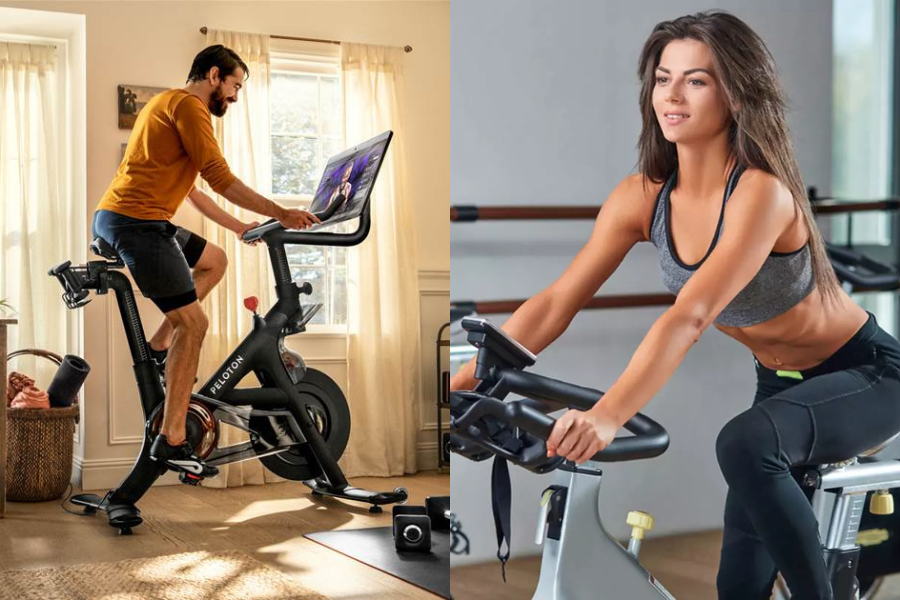
According to MerachFit, spin bikes tend to burn the most calories because they support very high intensity work and engage the entire lower body and core. Upright bikes follow close behind. Recumbent bikes usually burn the fewest calories since you are in a supported, reclined position that takes some load off your core (MerachFit).
If you like numbers, here is how they compare in general terms:
| Bike type | Typical use style | Relative calorie burn |
|---|---|---|
| Spin bike | High intensity, intervals, out of saddle | Highest |
| Upright bike | Moderate to high intensity, everyday cardio | Medium to high |
| Recumbent | Low to moderate intensity, joint friendly | Lowest |
This does not mean a recumbent bike is a bad choice. If you are rehabbing an injury or prefer more back support, recumbent cycling is still far better than being inactive. It simply means you may need slightly longer or more purposeful sessions to match the calorie burn of a shorter, harder spin bike ride.
Check how accurate your bike really is
You have probably wondered whether the calorie number on your bike screen is telling the truth. The short answer is that it is an estimate, and sometimes it is very generous.
PureGym reports that calorie burn on elliptical machines can be overestimated by 20 to 42 percent because the machine counts some of the help you get from momentum, and their guide suggests that bike estimates can also be off if the machine does not know your weight or settings precisely (PureGym).
We R Sports explains that exercise bike calorie counters vary in accuracy by brand and model. Newer bikes tend to be better because they factor in more variables such as your weight, age, and sometimes gender. Even then, individual physiology still affects the real number, so the estimate might not fit you exactly (We R Sports).
Users in the Reddit Fitness community note that power meters are the most accurate way to measure calories. Heart rate monitors are less accurate than power, but they are usually better than trusting the bike screen alone (Reddit Fitness). Their practical advice is to focus on consistency rather than obsessing over a single number and to assume that the real burn is often a bit lower than the display suggests.
If you want the best estimate, try a calculator that uses your weight, duration, and either intensity level or watts. The Stationary Bike Calorie Calculator from runbundle is one example and it works for many bike types, including recumbent models (runbundle).
Use intervals to boost calorie burn
If you want to increase your exercise bike calorie burn without spending all evening riding, interval training is your friend.
HIIT, High Intensity Interval Training, and REHIT, Reduced Exertion HIIT, pack intense efforts into short workouts. CarolBike notes that interval methods like these burn substantially more calories than steady state cycling of the same duration and they elevate your calorie burn for hours afterward thanks to EPOC, the Excess Post Exercise Oxygen Consumption effect (CarolBike).
Their research summary includes some striking points:
- A 15 minute REHIT bike workout can burn more total calories, including afterburn, than a 30 minute run, with about 66 percent of the calories burned in the hours after the workout (CarolBike)
- Short, maximum intensity sprints, such as 2 sets of 20 seconds all out, can raise your metabolic rate for up to 48 hours, which makes them very efficient for fat loss (CarolBike)
You do not have to jump straight into all out sprints. You can start with simple intervals like:
- 1 minute hard, 2 minutes easy, repeated 6 to 8 times
- 30 seconds faster pedaling, 90 seconds gentle spin, repeated 10 to 12 times
As your fitness improves, you can gradually increase resistance during the hard segments or reduce your rest time. The key is that your hard intervals feel meaningfully tougher than your easy ones.
Add resistance and position changes
Two simple tweaks can raise your exercise bike calorie burn without making your ride feel like a punishment: resistance changes and brief standing segments.
MerachFit points out that higher resistance levels recruit more muscle and can raise your calorie burn significantly compared to fast, low resistance spinning (MerachFit). Hill style rides, where you gradually turn up resistance to simulate climbing, can burn up to 1,000 calories per hour at very high efforts, according to research summarized by CarolBike (CarolBike).
Pedaling while standing, often called riding out of the saddle, also helps. A 2016 study referenced by CarolBike found that standing increases metabolic cost because your upper body has to work harder to support you, which results in a higher calorie burn than seated cycling, especially during sprints and hill repetitions (CarolBike).
You can apply these ideas in your own workout by:
- Adding a 1 or 2 minute “hill” every 5 minutes, where you increase resistance and either stay seated or stand briefly
- Standing for 15 to 30 seconds at the top of every song during a music based ride
- Using a ladder structure where you raise resistance slightly every few minutes and then drop back down for a recovery block
Short, thoughtful changes like these can lift your calorie burn without needing a completely new routine.
Track smarter, not harder
To make steady progress with weight loss or fitness, the goal is not to chase one perfect calorie number. The goal is to create consistent patterns that use more energy than you take in, while still feeling sustainable.
You will get the most useful feedback if you:
- Use your bike’s watt or resistance levels to track effort over time
- Wear a fitness tracker or heart rate monitor if you want better calorie estimates than the built in bike counter, since these tools consider your personal details (We R Sports)
- Log your workouts, including time, perceived effort, and any intervals you used
Exercise bike calorie counters and calculators are helpful, but they are still estimates. If you pay attention to trends, such as your ability to ride at higher resistance or your resting heart rate improving, you will see progress even when the exact calorie numbers vary.
Start with one small change in your next ride, maybe a couple of short intervals or a slight bump in resistance, and notice how much more effective your workout feels. Over time, those small upgrades in your exercise bike calorie burn can add up to real changes in your weight, energy, and health.
About the Author