A strong glute workout gym routine does more than change how your jeans fit. Your glutes support your posture, power your stride, protect your lower back, and help you move better in almost every activity you do. When you train them with intention, you feel the results in your workouts and in everyday life.
Below, you will learn how your glute muscles work, the most effective gym exercises to train them, and how to put everything into a simple, repeatable routine you can follow each week.
Understand your glute muscles
Before you load up a barbell, it helps to know what you are actually trying to train. Your glute muscles are a group of three:
- Gluteus maximus: The largest and most powerful, responsible for hip extension and external rotation of the thigh. It is what helps you stand up from a squat, climb stairs, run, and jump. The gluteus maximus is often described as the most powerful muscle in the body.
- Gluteus medius: Located on the outer side of your hip, it stabilizes your pelvis when you walk or stand on one leg. It also helps with hip abduction, which is moving your leg out to the side.
- Gluteus minimus: The smallest, sitting underneath the medius. It also assists in hip abduction and provides pelvic stability.
Developing all three is important for hip stability, injury prevention, athletic performance, and aesthetics, as several training guides emphasize. When you train only the big, obvious moves and ignore stability work, you tend to feel it in your knees, hips, or lower back later.
Why a glute workout gym routine matters
A focused glute workout gym plan is not just about building muscle. Strong glutes can help you:
- Improve posture by supporting your pelvis and spine
- Boost performance in running, cycling, and lifting
- Reduce your risk of lower back and knee injuries
- Maintain better balance in single leg movements
- Feel more confident in how you move and look
Glute activation exercises are especially useful as part of your warm up. Simple bodyweight drills help you wake up the gluteus maximus, medius, and minimus so that they actually work during your main lifts. Peloton instructors and physical therapists highlight how this improves mind muscle connection and exercise efficiency, while lowering injury risk.
If you are a runner or cyclist, getting your glutes firing before a session can make a noticeable difference in power and form, according to Peloton fitness experts.
Start with glute activation in the gym
Think of activation as turning the lights on before you start work. You do not need a long routine. Five to ten minutes is enough to prime the muscles so your heavy sets feel smoother and more stable.
You can perform these with bodyweight or light resistance bands:
- Glute bridges
- Clamshells
- Banded lateral walks
- Standing hip abductions
- Hip thrusts with very light weight
- Step ups
Peloton’s glute activation guide demonstrates how moves like hip thrusts, step ups, banded lateral walks, standing hip abduction, clamshells, and single leg deadlifts target different areas of the glutes without needing to squat.
Aim for 1 to 2 light sets of 12 to 20 reps on 2 or 3 of these before your main workout. Focus on slow control and a strong squeeze at the top of each rep. When you start feeling your glutes burn slightly, you are ready to move on.
Best compound glute exercises in the gym
Compound exercises use more than one joint and muscle group at a time. They give you the most return for your effort, so they should form the foundation of your glute workout gym routine.
According to several strength coaches and guides, some of the best compound moves for glute growth and strength include squats, Romanian deadlifts, Bulgarian split squats, step ups, deadlifts, and hip thrust variations.
Squats
Squats hit your quads and core, but they are also a powerful glute builder, especially when you use heavier loads.
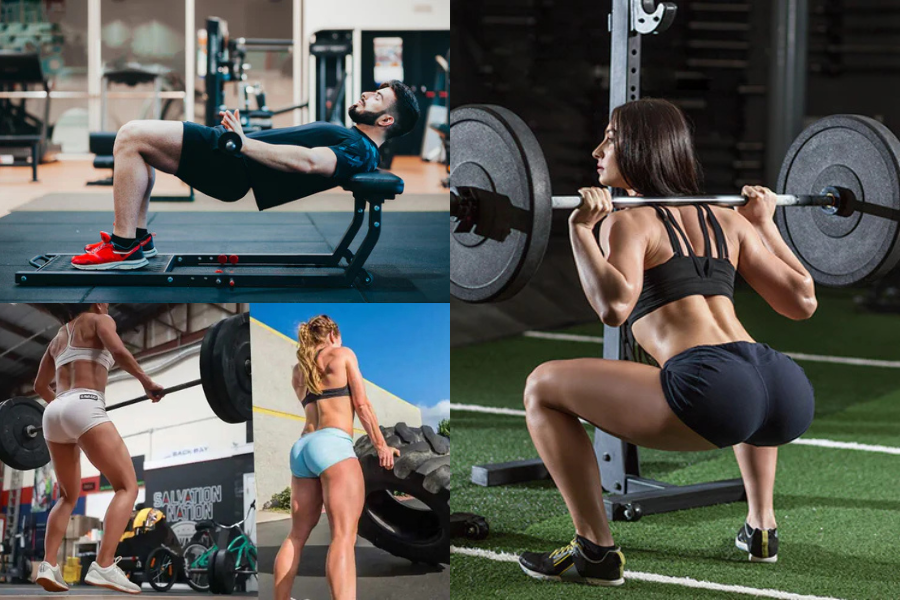
- Back squats: Great for overall lower body strength. Higher loads close to 90 to 100 percent of your one rep max significantly increase glute engagement, which is why they show up in almost every serious glute program.
- Sumo squats: A wider stance with toes turned out emphasizes the glutes and inner thighs more.
- Front squats: Shift some focus to the quads and core, but still demand strong glute support, especially as you drive up from the bottom.
Think about sitting back and down, keeping your knees in line with your toes, and pushing the floor away as you stand.
Romanian deadlifts (RDLs)
Romanian deadlifts are one of the best hinge pattern exercises for your posterior chain. Dumbbell RDLs offer excellent range of motion and overloading potential, strengthening your hamstrings, glutes, and back, while also challenging your midsection.
Key technique cues:
- Keep a soft bend in your knees
- Hinge at the hips as if closing a car door with your glutes
- Maintain a flat back and keep the weights close to your legs
- Stop when you feel a deep stretch in your hamstrings, then drive your hips forward to stand
Deadlifts
Conventional or trap bar deadlifts are full body strength builders that heavily involve the glutes. They can be more fatiguing than RDLs, so place them earlier in your workout and avoid doing them heavy every session if you are a beginner.
Bulgarian split squats
Bulgarian split squats, a type of rear foot elevated split squat, challenge your balance and single leg strength. They are especially useful for targeting the glutes because of the large hip flexion on the front leg.
You can adjust your stance slightly forward to feel more glute engagement. Keep your torso slightly leaning forward and focus on pushing through the heel of your front foot as you stand.
Step ups
Step ups mimic real world movements like climbing stairs and hills. They train each leg independently and demand a lot from your glutes and stabilizers.
Choose a box height where your knee is at or just above a right angle. Lean slightly forward, push through your front heel, and avoid launching off the back leg. Controlled descents build strength and protect your knees.
Best isolation exercises for glutes
Isolation exercises focus more directly on the glute muscles so you can add extra volume without overloading your joints. These are ideal after your big compound lifts.
Research and coaches frequently highlight these as top glute isolation moves:
Hip thrusts
Barbell hip thrusts are one of the most effective exercises for targeting the gluteus maximus. Studies and training guides have found they activate the glutes more than back squats and split squats, making them a cornerstone for glute growth and power.
Important setup points:
- Upper back on a bench, feet flat on the floor
- Shins vertical at the top of the rep
- Chin slightly tucked, ribs down
- Drive through your heels and squeeze your glutes hard at the top without overarching your lower back
You can start with bodyweight or a dumbbell across your hips. The dumbbell hip thrust is beginner friendly and lets you focus on form and activation, although it has less overloading capacity than a barbell because of how you hold the weight.
Glute bridges
Glute bridges are a shorter range cousin of the hip thrust. They are done lying on the floor instead of with your back elevated. For beginners or as part of a warm up, they are ideal. As you progress, you can add a barbell, dumbbell, or mini band to increase challenge.
Glute kickbacks
Cable or banded glute kickbacks target hip extension in a very direct way. Focus on small, controlled movements and avoid arching your back. Think of pushing your heel back and slightly up, and pausing briefly at the top of each rep.
Good mornings
Good mornings are another hinge that emphasizes the glutes and hamstrings. Start light and treat them as a form and control exercise before loading heavily.
How often to train glutes
If glute growth is your main goal, you will want to work them more than once a week. Several coaches and resources suggest:
- Training glutes 2 to 4 times per week for optimal progress, as long as you manage recovery well.
- Allowing at least 48 hours between hard sessions for the same muscle group so your body can repair and grow.
- For general health rather than maximal growth, 2 to 3 glute focused sessions per week is usually enough.
Bret Contreras, often called a leading expert on glute training, notes that roughly 3 times per week is a good target for many lifters, although an effective range can be anywhere from 2 to 6 times depending on genetics, volume, load, effort, and your overall program.
If you are new to lifting, start with two glute focused days and see how your body responds. You can always add a third once your recovery and technique improve.
Choose the right sets, reps, and weight
To build strong, defined glutes, you need a mix of rep ranges and a focus on progressive overload. Resistance training creates tiny tears in the muscle fibers, and as your body repairs them, your muscles grow and get stronger.
A balanced approach looks like this:
- 4 to 8 reps: Heavy sets for pure strength
- 8 to 12 reps: Moderate weight for hypertrophy, that is, muscle growth
- 12 to 15 reps: Lighter weight for muscular endurance and a strong pump
Many gym programs for glute growth combine all three ranges in a single week to hit different adaptations.
No matter the rep range, the weight should feel challenging, especially in the last 2 or 3 reps, but you should still maintain solid form. If you could perform five more reps at the end of a set, it is time to increase the load slightly.
Simple guideline: when a set feels noticeably easier for two workouts in a row, add a small amount of weight or an extra rep to keep progressing.
Sample glute workout gym plan
Use this as a template you can adapt to your experience level and schedule. Perform it 2 or 3 times per week, leaving at least one rest day between sessions.
Warm up and activation
- 5 minutes of light cardio, for example brisk walking or cycling
- 1 to 2 sets each of:
- Glute bridges, 15 to 20 reps
- Banded lateral walks, 10 to 15 steps each way
- Clamshells, 12 to 15 reps per side
Main workout
- Barbell hip thrusts
- 3 to 4 sets of 8 to 12 reps
- Focus on a full lockout and strong squeeze at the top
- Romanian deadlifts
- 3 sets of 6 to 10 reps
- Keep tension in your hamstrings and glutes throughout
- Bulgarian split squats
- 3 sets of 8 to 12 reps per leg
- Use bodyweight or dumbbells depending on your level
- Step ups
- 3 sets of 10 to 12 reps per leg
- Control the descent and avoid bouncing off the back foot
- Glute kickbacks or standing hip abduction
- 2 to 3 sets of 12 to 15 reps per side
- Use a cable or resistance band for consistent tension
Finish with light stretching for your hips, hamstrings, and lower back.
If you are a beginner, start with fewer sets and lighter weight. As you adapt, you can gradually increase one variable at a time, like adding one extra set to your main lift or a small amount of weight.
Make your glute training sustainable
Consistency matters more than any single perfect workout. Research and coaching experience suggest that training glutes two to four times per week and sticking with it for a couple of months is enough for most people to start seeing clear progress, provided your nutrition and sleep are reasonably in line.
To keep your glute workout gym routine sustainable:
- Rotate some exercises every 6 to 8 weeks to stay mentally fresh
- Track your weights so you can apply progressive overload steadily, not randomly
- Respect recovery, soreness is normal, sharp pain is a sign to back off
- Pair your training with enough protein and overall calories to support growth
Strong glutes pay you back every time you walk, run, lift, or simply stand. Start with a simple routine, focus on quality reps, and build up gradually. With a few months of consistent training, you will feel the difference in both your workouts and everyday movement.
About the Author