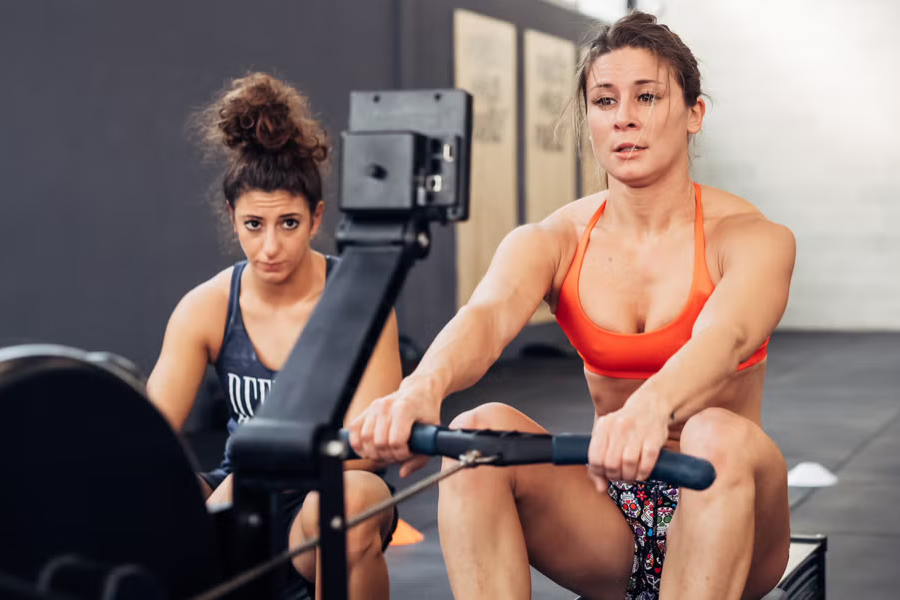
A rowing machine might look simple, but rowing workouts at home can completely change the way you feel in your body. In a short amount of time, you can improve your cardio fitness, build strength from head to toe, and work toward weight loss without pounding your joints on a treadmill or pavement.
Below, you will learn how at-home rowing benefits your body, what proper form looks like, and how to structure workouts that fit your goals and schedule.
Why rowing workouts at home are so effective
Rowing is often called a total body workout for a reason. When you row correctly, about two-thirds of the effort comes from your legs and the rest from your upper body and core. That means you are training multiple major muscle groups at once, including your legs, glutes, back, arms, and abdominals, instead of isolating just one area (Healthline).
Because all of that muscle is working together, your heart rate climbs quickly and stays elevated. The Cleveland Clinic notes that rowing provides cardiovascular benefits that are similar to running but with less impact on your joints (Cleveland Clinic). You get both cardio and strength in one workout, which makes each minute you spend on the machine count for more.
For home use, there is another big plus. Many rowing machines are tall, lightweight, or foldable and can be stored upright or slid into a corner when not in use. This makes them easy to fit into a living room, bedroom, or garage gym, even if you do not have a dedicated workout room (Healthline, Men’s Health).
Key health benefits you can expect
Rowing can support your health on several fronts at once. When you stick with rowing workouts at home, you give yourself a convenient way to move more often without commuting to a gym.
Stronger heart and lungs
Rowing is a form of aerobic exercise. That means it trains your heart to pump blood more efficiently and helps your lungs use oxygen more effectively. The Cleveland Clinic explains that rowing helps build strength and stamina and can reduce stress at the same time (Cleveland Clinic).
You do not need marathon-length workouts to see benefits. Research summarized by Healthline points out that even short rowing sessions under 15 minutes, especially if done as high-intensity intervals, can significantly improve fitness and heart health (Healthline).
Support for weight loss and body composition
If weight loss or fat loss is one of your goals, rowing can help you create the calorie deficit you need without spending hours working out. For example, a 155 pound person can burn around 369 calories in just 30 minutes of vigorous rowing (Healthline).
Some sources note that very intense rowing can burn up to 500 calories in half an hour, which makes it one of the more efficient indoor cardio options (Red Beard Sailing). Because rowing also builds muscle, it can help you maintain or increase lean mass while you are losing weight, which is important for a healthy metabolism.
Low impact, friendly on your joints
Rowing is gentle on your ankles, knees, and hips compared with activities like running or plyometric workouts. Both the Cleveland Clinic and Healthline highlight rowing as a low-impact option that is suitable for many people, including those with early stages of osteoarthritis or those who need to avoid high impact exercise (Cleveland Clinic, Healthline).
This makes it useful for:
- Active recovery days when you want to move but not stress your body
- People returning to exercise after a break, with approval from a healthcare provider
- Anyone who feels beat up after higher impact workouts
Full body strength and endurance
You might think of rowing as “cardio,” but it is also serious strength work. Rowing machines typically involve about 65 to 75 percent leg work and 25 to 35 percent upper body work, engaging your legs, arms, back, and core in every stroke (Healthline).
Men’s Health notes that the leg drive and back engagement in rowing challenge your muscles while also raising your heart rate, so you build muscular strength and endurance along with cardio fitness (Men’s Health). This is especially valuable if you are short on time and want one piece of equipment that addresses both strength and conditioning.
How often you should row at home
You might be wondering how much is enough. The Cleveland Clinic, citing CDC guidance, suggests aiming for about 20 minutes of moderate intensity rowing a day to work toward cardiovascular and strength goals, then adjusting based on your fitness level and stamina (Cleveland Clinic).
You can use that as a starting point and shape it to your schedule:
- If you are a beginner, you might start with 10 to 15 minutes, three times a week.
- If you already exercise, you might do 20 to 30 minutes, three to five times per week.
- If you enjoy shorter sessions, you can try 10 to 15 minute high intensity interval workouts, where you alternate harder and easier rowing.
Consistency matters more than perfection. It is better to row for a moderate amount of time several days a week than to push one massive session and then skip the rest of the week because you feel wiped out.
Mastering proper rowing form
Proper form is the key to getting results while avoiding back or shoulder pain. Rowing has four basic parts: catch, drive, finish, and recovery. The Cleveland Clinic and Men’s Health both emphasize that learning these positions helps prevent common issues like lower back strain and shoulder discomfort (Cleveland Clinic, Men’s Health).
Think of the stroke as a smooth cycle rather than four separate moves.
The four parts of the stroke
-
Catch
Sit tall at the front of the machine. Your knees are bent, shins roughly vertical, arms straight, and shoulders relaxed. Your torso leans slightly forward from the hips, not rounded from the upper back. Your weight is mostly in your heels, even though your feet are strapped in. -
Drive
Start the movement by pressing through your heels and extending your legs. Your arms stay straight as your legs do most of the work. When your legs are almost fully extended, lean your torso back a little from the hips, then pull the handle in toward your lower ribs. -
Finish
At the back of the stroke, your legs are straight but not locked, your torso leans back slightly, and your elbows are drawn behind you with the handle close to your sternum. Your shoulders remain down and relaxed rather than scrunched toward your ears. -
Recovery
To return to the start, reverse the motion in order. First, extend your arms forward. Then hinge your torso forward from the hips. Finally, bend your knees and glide back to the catch position. The recovery should be controlled and a bit slower than the drive.
Men’s Health describes this same sequence for at-home rowing, and mastering it will make your workouts safer and more effective (Men’s Health).
Simple form reminders
As you row, keep these cues in mind:
- Legs, then body, then arms on the drive.
- Arms, then body, then legs on the recovery.
- Sit tall, avoid rounding your lower back.
- Keep your grip relaxed so your forearms do not burn out first.
If something starts to hurt in a sharp or unusual way, stop and reassess your form or check in with a professional.
Sample rowing workouts you can do at home
Once you feel comfortable with basic form, you can start to structure rowing workouts at home based on your goals. Men’s Health highlights that rowing workouts are very scalable, so you can adjust pace, time, and rest to suit your level, and then increase intensity as you get fitter (Men’s Health).
Here are a few ideas you can adapt.
1. Beginner steady state session
If you are new to rowing or coming back after time off, start here.
- 3 to 5 minutes easy rowing to warm up
- 10 minutes at a moderate pace where you can still talk in short sentences
- 2 to 3 minutes easy rowing or complete rest to cool down
Aim to keep your strokes smooth and focus on the leg drive. Over time, you can extend the main block to 15 or 20 minutes.
2. Time efficient interval workout
If you are short on time, intervals can give you a strong cardio stimulus in under 20 minutes. Healthline notes that even sub 15 minute sessions of high intensity work can significantly improve fitness when done consistently (Healthline).
Try this:
- 5 minutes easy warm up
- 8 rounds of: 40 seconds hard rowing, 20 seconds very light rowing or rest
- 4 to 5 minutes easy cool down
Adjust the hard pace so you feel challenged but can maintain good form through all eight rounds.
3. Strength plus rowing circuit
One of the advantages of rowing at home is that you can mix it with other moves for a full body circuit. Men’s Health offers several examples of workouts that pair rowing with exercises like kettlebell swings, burpees, and core work for intense conditioning sessions (Men’s Health).
You can create a simple version with bodyweight or light weights:
- 250 meters rowing at a moderate pace
- 10 push ups
- 15 bodyweight squats
- 20 second plank
Rest 1 to 2 minutes, then repeat the circuit 3 to 5 times depending on your fitness level.
Tip: If you are a beginner, cut the reps in half or increase the rest between rounds. Your goal is to complete the workout with solid form, not to race through it.
When you do not have a rowing machine
If you are curious about rowing but do not own a machine yet, you can still mimic some of the benefits. Red Beard Sailing describes a few rowing substitutes that train similar muscles or provide comparable cardio, such as:
- Bent over barbell rows or inverted rows on a sturdy bar to target your back, lats, and traps
- Resistance band rows anchored to a door, which let you pull against adjustable resistance for strength or light cardio
- Elliptical machines or stationary bikes as low impact cardio options if you have access to them (Red Beard Sailing)
These alternatives will not feel exactly like a rowing machine, but they can help you start building strength and endurance while you decide if investing in a rower makes sense for you.
Making rowing a sustainable habit
The real transformation happens when rowing becomes part of your weekly rhythm rather than a one time experiment. A few ideas to help you stick with it:
- Set a specific schedule, such as rowing every Monday, Wednesday, and Friday morning.
- Keep the machine ready to go, for example set up in a corner instead of folded and hidden.
- Track simple metrics like time rowed or meters covered so you can see your progress.
- Mix in different styles of workouts, such as steady state days and interval days, to keep things interesting.
Rowing offers a rare mix of low impact movement, full body strength, and efficient calorie burning, all from a compact piece of equipment that fits in most homes. With good form and a realistic plan, your rowing workouts at home can become the foundation of better fitness, more energy, and long term health.
About the Author