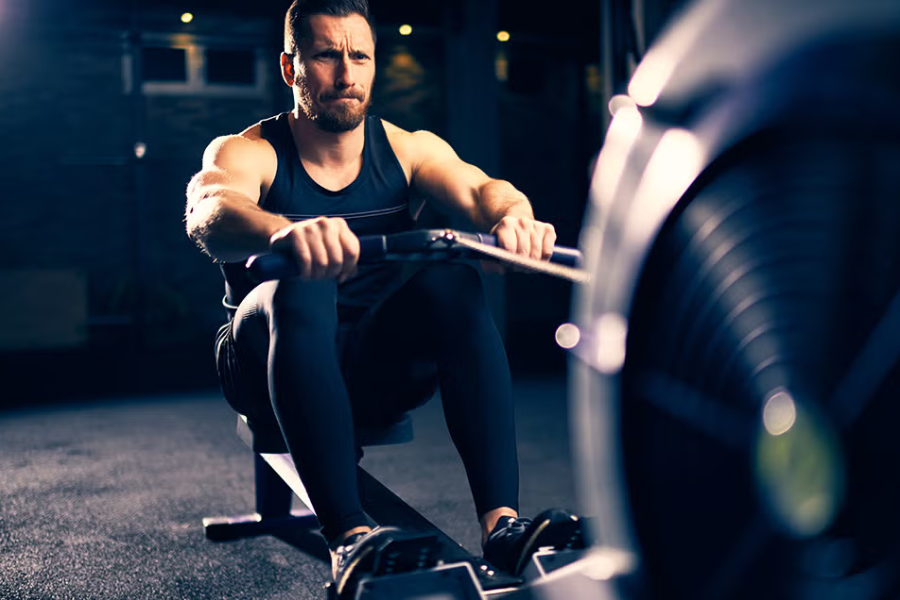
A rowing machine might look simple, but full body rowing workouts can quietly overhaul your fitness. In a single session you work your legs, core, back, and arms, raise your heart rate, and burn a surprising number of calories, all while sitting down and sparing your joints. If you are looking for efficient cardio that can help with weight loss and overall health, rowing is worth a closer look.
Why rowing counts as a true full body workout
When you row with proper form, you are not just pulling with your arms. You are driving through your legs, stabilizing with your core, and finishing with your upper body in one smooth motion. According to the American Fitness Professionals Association, rowing uses roughly 65 to 75 percent leg work and 25 to 35 percent upper body work, so your lower body does more of the heavy lifting than you might expect (Healthline).
That combination means you engage major muscle groups at once. Your quadriceps, hamstrings, calves, and glutes handle the leg drive. Your abdominals and lower back stabilize your torso. Your upper back, shoulders, and arms control the handle. Concept2 notes that every phase of the stroke, from the catch to the recovery, taps a different mix of muscles, so there is almost no moment when your body is not working in some way (Concept2).
Because you spread the effort across so many areas, you can work hard without overloading a single joint or muscle. This is one reason rowing is often recommended as a low impact, full body workout that still feels challenging and athletic.
How full body rowing workouts support weight loss
If your main goal is fat loss, full body rowing workouts give you several advantages at once. You burn calories during each session and you build or maintain lean muscle, which can support your metabolism between workouts.
Rowing Machine Workouts reports that you can burn roughly 300 calories in a 30 minute rowing session, depending on your pace and body size (Rowing Machine Workouts). Healthline cites an estimate of about 369 calories in 30 minutes of vigorous rowing for a 155 pound person, which is more than the same person would burn in an elliptical workout of equal length (Healthline). Since you are engaging around 86 percent of your muscles, according to trainer Sarah Craske, that higher effort shows up as a higher calorie burn (Fit&Well).
Beyond calories, rowing also builds lean muscle in your legs, back, and core. That muscle helps you perform daily tasks more easily and can increase your resting metabolic rate over time. A 2015 study found that rowing 5 days per week for 6 weeks decreased fat mass and total body fat percentage, and also improved cholesterol levels and back strength, even in people with low vision who may have had additional challenges to exercise regularly (Healthline).
When you combine regular rowing with balanced nutrition and enough recovery, you create an environment where your body can gradually reduce fat while becoming stronger and more resilient.
Cardio, strength, and health benefits in one
Rowing is usually grouped with cardio, but you will notice that it feels different from jogging on a treadmill or pedaling an exercise bike. You are pushing against resistance with your legs, pulling with your upper body, and coordinating your breathing, so you get a hybrid workout that touches both strength and endurance.
Cleveland Clinic notes that rowing challenges your cardiovascular system and builds stamina, while also strengthening your legs, upper back, core, glutes, and hamstrings (Cleveland Clinic). Because you stay seated and your feet remain planted, rowing is also considered low impact. It burns calories efficiently but is gentler on your joints compared with high impact options like running. This makes it a practical choice if you are managing early stage osteoarthritis or simply prefer to protect your knees and ankles (Healthline).
Regular use of a rowing machine can also improve posture and balance. As you strengthen your core and back, you support better spinal alignment and coordination in day to day movements, which Cleveland Clinic highlights as a way to reduce the risk of falls and chronic back issues (Cleveland Clinic).
You might also notice mental benefits. Like other rhythmic forms of cardio, rowing can reduce stress and improve mood, especially when you row at a steady pace for 20 minutes or more. NordicTrack notes that many people see better sleep and mood soon after starting consistent rowing sessions (NordicTrack).
Learn the basic rowing technique
To get the most from full body rowing workouts, good technique matters more than raw effort. Proper form lets you tap into powerful leg muscles and protects your back, shoulders, and knees.
Most rowing coaches break the stroke into four positions:
-
The catch
You sit tall with your knees bent, shins roughly vertical, arms straight, and torso leaning slightly forward from the hips. Your wrists stay flat and you hold the handle with a relaxed grip. Sunny Health and Fitness emphasizes a neutral spine here, not a rounded back, so you can transfer power safely when you start to drive (Sunny Health and Fitness). -
The drive
Push through your heels and mid foot to extend your legs while your arms remain straight. Your core stays engaged as your torso swings gently from a forward lean to a slight backward lean. Only after your legs are nearly straight do you begin to pull the handle in toward your torso. The power sequence is legs, hips, then arms. -
The finish
At the end of the stroke, your legs are extended but not locked, your torso leans slightly back, and the handle rests just below your ribs. Your elbows track back, wrists remain flat, and your core stabilizes your spine. Concept2 notes that your abdominals, glutes, quads, biceps, and back muscles are all active in this position (Concept2). -
The recovery
You reverse the sequence in a controlled manner. First extend your arms forward, then hinge your torso to a forward lean, and finally bend your knees to slide back to the catch. British Rowing stresses a relaxed, unhurried recovery so you can prepare for the next powerful drive and maintain rhythm without overtaxing your muscles (British Rowing).
British Rowing also recommends keeping a neutral back position throughout, which means your spine stays flat and you pivot from the hips instead of curling from the mid back. This simple habit protects your spine and helps you connect leg power to the handle efficiently.
If you are unsure about your form, you can film yourself from the side or use a mirror to check that you are driving mostly with your legs, not pulling early with your arms. Sunny Health and Fitness suggests this kind of visual feedback as a practical way to refine your stroke and avoid common mistakes such as overextending the knees or hunching the shoulders (Sunny Health and Fitness).
Structure a full body rowing routine for results
Once you are comfortable with the basic stroke, you can start to structure your workouts for fat loss, fitness, or both. The good news is that you do not need to row every day. Rowing Machine Workouts suggests a 4 week plan with 4 rowing sessions per week, each including a warm up, a main set, and a cool down, using a mix of high intensity intervals, medium duration intervals, and longer steady rows (Rowing Machine Workouts).
Fit&Well shares a 30 day plan that also combines short, intense efforts, low intensity steady rows, distance challenges, and floor exercises, plus regular rest days to allow your muscles to recover and grow (Fit&Well). You can adopt a similar pattern:
- Two days per week focused on steady, moderate effort for 20 to 35 minutes
- One or two days per week focused on intervals, where you alternate hard efforts with easy rowing or rest
- At least 3 rest or active recovery days per week, especially when you are starting
Your stroke rate, which is the number of strokes per minute, is another useful guide. Rowing Machine Workouts recommends a moderate 20 to 26 strokes per minute for many sessions so you can maintain good form and consistent pacing (Rowing Machine Workouts). You can occasionally row a bit faster during intense intervals, but it is better to build power through your leg drive rather than simply rushing your strokes.
Garage Gym Reviews advises beginners to monitor basic metrics like elapsed time, stroke rate, and perceived effort before getting too focused on distance or split times (Garage Gym Reviews). As your fitness improves, you can track your pace per 500 meters or your average watts to see clear progress.
Sample beginner friendly rowing sessions
To make all of this more practical, you can start with a couple of simple rowing workouts and adjust them based on how you feel. Always include a warm up and cool down so your body has time to adapt.
Steady state full body row
This session builds your aerobic base and gives you time to practice technique.
- Warm up: 5 minutes of easy rowing at 18 to 22 strokes per minute
- Main set: 15 to 20 minutes at a pace where you can still speak in short phrases, staying around 20 to 24 strokes per minute
- Cool down: 5 minutes of very easy rowing followed by light stretching
Keep your focus on smooth drives with the legs, relaxed hands, and controlled recoveries. This type of steady work is the backbone of many beginner programs and helps you meet the CDC guideline of at least 150 minutes of moderate intensity exercise per week when combined with a few other sessions (Cleveland Clinic).
Interval based rowing workout
This session introduces higher intensity while keeping total time manageable.
- Warm up: 5 minutes easy
- Main set: 8 rounds of 1 minute hard, 1 minute very easy
- Hard intervals at about 24 to 28 strokes per minute, focusing on strong leg drive
- Easy intervals at 18 to 20 strokes per minute or even full rest if needed
- Cool down: 5 minutes easy
Garage Gym Reviews notes that short interval formats like this can build cardiovascular and muscular endurance without requiring long workouts, which is helpful if you have a busy schedule (Garage Gym Reviews).
Listen to your body as you try these. If you are new to exercise, reduce the number of intervals or shorten the main set. If you already have a fitness base, you can extend the work portion or add another set of intervals after a brief rest.
Recovery, rest days, and basic nutrition
Because full body rowing workouts involve so many muscles, recovery is part of the program, not an optional extra. Both Rowing Machine Workouts and Fit&Well emphasize the importance of rest days, often at least 3 per week in beginner routines, to prevent injury and allow for muscular repair (Rowing Machine Workouts, Fit&Well).
On non rowing days, you can walk, stretch, do gentle mobility work, or use a foam roller to ease any soreness and keep blood flowing. Fit&Well specifically recommends foam rolling to help with delayed onset muscle soreness, which can be common when you first start using new muscle groups regularly (Fit&Well).
Basic fueling also supports your results:
- Before rowing: a high carbohydrate meal 2 to 4 hours before a hard session can give you steady energy, or a smaller carb based snack if you are closer to workout time
- After rowing: a light snack with carbohydrates and protein helps replenish energy stores and supports muscle repair, followed by balanced, protein rich meals through the day (Fit&Well)
Hydrate before, during, and after your workout, especially if you tend to sweat heavily. You do not need special drinks for most sessions. Water is usually enough unless you are rowing very intensely or for longer than an hour.
When you can expect to notice changes
If you row consistently and pay attention to form, you may feel small changes quickly. Your technique will become smoother, your heart rate will recover faster after intervals, and daily activities like climbing stairs may feel easier. Cleveland Clinic notes that many people see visible fitness improvements within a couple of weeks of regular rowing practice (Cleveland Clinic).
Changes in body composition, such as fat loss and muscle tone, usually take longer and depend on your overall routine, including diet and sleep. The 2015 rowing study that reported reduced body fat and better cholesterol did so over 6 weeks of frequent training, which can give you a rough sense of timelines for more measurable changes (Healthline).
You do not need to chase perfection to benefit. Start where you are, aim for two to four full body rowing workouts per week, and keep your technique clean. Over time, small, steady efforts on the rower can add up to stronger muscles, a healthier heart, and a more energized day to day life.
About the Author