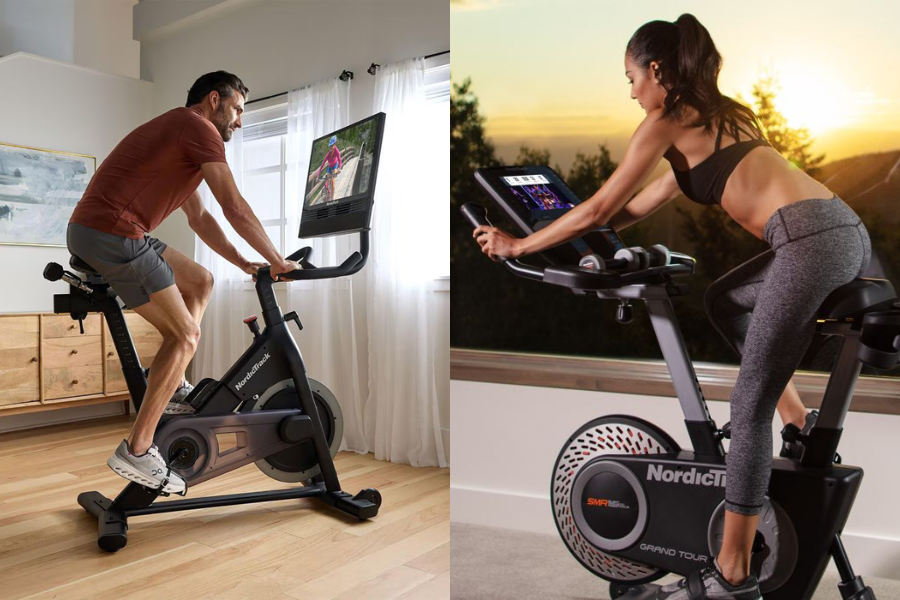
A stationary bike might look simple, but it can be one of the most effective tools you use for fat loss and better health. Exercise bike workouts for weight loss work so well because they let you burn a lot of calories, protect your joints, and stay consistent without needing perfect weather or a packed schedule.
Below, you will see why the exercise bike deserves a place in your routine and how to use it in a way that actually supports your goals.
Why exercise bikes are so effective for weight loss
When you are trying to lose weight, you are really trying to burn more energy than you take in. The exercise bike helps you do that in a few key ways.
First, it burns a meaningful number of calories in a short time. Harvard Health data cited by PureGym suggests that 30 minutes of moderate cycling on a stationary bike can burn about 210 calories for a 125 pound person, 252 calories for a 155 pound person, and 294 calories for a 185 pound person. Vigorous cycling raises that to around 315, 378, and 441 calories respectively (PureGym). Over a week, that adds up quickly.
Second, the bike is low impact and joint friendly. Unlike running or jumping exercises, cycling keeps your feet on the pedals, which reduces stress on your ankles, knees, and hips. This makes it a smart choice if you carry extra weight, have joint pain, or are coming back from an injury (PureGym, Healthline).
Finally, it is easy to stick with. You can ride at home, in the gym, or in a spin class. You do not need special skills, and you can start with just a few minutes at a time and build up. That consistency is what drives long term results.
How many calories you can burn
Calorie burn is one of the big reasons exercise bike workouts for weight loss are so popular. The exact number depends on your weight, effort level, and how long you ride.
Healthline notes that you can burn more than 600 calories per hour on a stationary bike if you work at a higher intensity (Healthline). Even at moderate efforts, the numbers are impressive, especially if you ride several times per week.
If your bike or app tracks power in watts, you can get a more accurate idea:
- Cycling at about 100 watts for 15 minutes burns roughly 90 calories
- Increasing to 200 watts for the same 15 minutes burns around 180 calories
These estimates come from a fitness community discussion that highlighted wattage as the most reliable way to gauge calorie burn on a stationary bike (Reddit r/Fitness).
If your bike does not show watts, tools like the stationary bike calorie calculator from RunBundle let you enter your weight, workout duration, and intensity level to estimate calories burned. The calculator uses METs, a measure of effort where 1 MET is resting and about 6 METs roughly equals cycling at 100 watts, to turn your effort into a calorie estimate (RunBundle).
The exact number is less important than the pattern. When you ride regularly and keep your effort honest, you significantly increase your total daily energy expenditure, which is what supports fat loss.
Why low impact matters for consistency
You can only benefit from a workout if you can repeat it often enough. This is where the bike’s low impact design shines.
Stationary biking provides a challenging aerobic workout while minimizing impact on your joints. Healthline and Verywell Fit both highlight that stationary bikes protect your joints, which is especially helpful if you have knee or ankle issues or are recovering from an injury (Healthline, Verywell Fit).
Since you are less likely to feel beat up after riding, you can:
- Train more days per week
- Combine cycling with strength training
- Progress intensity and duration without as much injury risk
That ability to show up again and again is usually what separates short term attempts from lasting change.
LISS vs HIIT: Two powerful approaches
You can use an exercise bike in more than one way, and both can support weight loss when used well.
LISS: Easier pace, longer rides
Low Intensity Steady State cardio, often called LISS, means riding at a comfortable pace that you can maintain while still holding a conversation. PureGym notes that doing LISS cycling 2 to 3 times per week for 30 to 60 minutes can significantly increase your weekly calorie burn. For example, a 155 pound person doing three 60 minute LISS rides can burn around 1,512 calories per week, which is a large contribution toward losing about 1 pound of fat (PureGym).
LISS is useful when you:
- Are a beginner or returning after a break
- Have joint or health concerns and want a gentler option
- Prefer steady, more meditative workouts
You get solid calorie burn, better endurance, and more confidence on the bike.
HIIT: Short, intense intervals
High Intensity Interval Training, or HIIT, uses short bursts of hard work followed by easier pedaling to recover. According to PureGym, HIIT on an exercise bike usually lasts 10 to 20 minutes and involves working very hard during the intervals, then easing off between rounds. This style can burn a lot of calories during the session and can also increase your calorie burn afterward as your body recovers (PureGym).
Self magazine cites indoor cycling pros who recommend intervals at different effort levels, from easy riding to near all out sprints, because varying your intensity gives you more fat burning benefits than riding at only one speed (SELF).
Studio Three also notes that HIIT cycling, where you push to about 80 to 95 percent of your maximum heart rate during work intervals, can deliver a very effective cardiovascular workout in about 30 minutes. Since it burns many calories in a short time, it fits well into busy schedules and supports weight loss when paired with a balanced diet (Studio Three).
If you enjoy a challenge and want time efficient sessions, HIIT can be a strong option once you have a solid base of fitness.
Sample workout ideas to get started
You do not need a complicated plan to benefit from exercise bike workouts for weight loss. These simple structures can help you begin or add variety.
Beginner steady ride
Verywell Fit suggests that you can start with just a few minutes at a time and gradually build to a 30 minute ride, which meets basic daily exercise recommendations for endurance and calorie burning (Verywell Fit).
You could try:
- 5 minutes easy pedaling to warm up
- 15 to 20 minutes at a comfortable, moderate pace
- 5 minutes easy cool down
As that feels easier, extend the middle segment by a few minutes each week until you reach 30 minutes or more.
Simple interval progression
Once you are comfortable riding for 20 to 30 minutes, you can add gentle intervals. One approach, based on Verywell Fit’s guidance, is to alternate baseline and harder efforts (Verywell Fit).
For example:
- Warm up for 5 minutes at an easy pace
- Ride 3 minutes at your normal pace
- Increase resistance or speed for 2 minutes to a noticeably harder, but manageable level
- Repeat steps 2 and 3 for 4 to 6 rounds
- Cool down 5 minutes easy
This style boosts cardiovascular fitness and calorie burn without needing all out sprints.
Time efficient HIIT options
For more advanced intervals, you might use well known patterns mentioned in the research:
- Tabata style: 20 seconds very hard, 10 seconds easy, repeated in short blocks
- 10 20 30: 30 seconds easy, 20 seconds moderate, 10 seconds hard, repeated in cycles
Both methods were developed or tested using stationary bikes and have been recommended for fat loss and cardiovascular gains by coaches cited in Self magazine (SELF).
Always warm up thoroughly before these sessions and keep them short, usually 10 to 20 minutes of intervals plus warm up and cool down.
What the research says about results
If you are wondering whether this all actually works in real life, there is research that says yes.
A 2010 study discussed by Healthline looked at people who combined indoor cycling with a 1,200 calorie daily diet over 12 weeks. Participants cycled for 45 minutes three times per week and saw reductions in body weight, body fat, cholesterol, and triglycerides (Healthline).
Other sources in the research highlight that stationary bike workouts:
- Build cardiovascular endurance and leg strength for people at many fitness levels (SELF)
- Provide similar cardio benefits to treadmills and ellipticals, but with less joint stress (Verywell Fit)
- Support fat loss especially well when you use intervals and combine cycling with a balanced, portion conscious diet (Studio Three)
You still need to pay attention to your food choices, since you cannot out cycle a consistently high calorie intake. However, the bike gives you a reliable, manageable way to raise your daily energy output.
If you focus on riding regularly, adjusting intensity, and pairing your workouts with realistic nutrition, the stationary bike can be more than just a piece of cardio equipment. It becomes a steady tool for long term weight and health changes.
Practical tips to make your rides count
A few small habits can make your exercise bike workouts for weight loss more effective and more enjoyable:
- Aim for at least three cardio sessions per week. Verywell Fit recommends this as a baseline for building endurance and burning calories (Verywell Fit).
- Mix steady rides with one interval session. Coaches quoted by Self suggest combining moderate steady workouts at about 60 to 70 percent of your max heart rate with one higher intensity interval session to maximize fat loss (SELF).
- Do not rely blindly on the bike’s calorie display. These readouts are often inaccurate. If possible, pay attention to watts or use a calculator like RunBundle’s to get a better estimate, then mainly track your consistency and progress over time (RunBundle, Reddit r/Fitness).
- Fuel smart around tougher sessions. Studio Three suggests doing HIIT cycling a couple of hours after a meal that includes carbohydrates so you have enough energy to train hard without crashing (Studio Three).
- Start where you are. Even 10 minutes is useful, especially if you are new or pressed for time. The key is not to overestimate the calories burned, but to focus on building a routine you can maintain (Reddit r/Fitness).
If you are unsure how to begin, pick one small change you can make this week. That might be riding for 10 minutes after dinner three nights in a row or swapping one walk for a gentle 20 minute bike session.
Once you feel the rhythm of regular riding, you can layer in intervals, track your effort more closely, and adjust your nutrition. Over time, those simple sessions on the bike can add up to meaningful weight loss and stronger, more reliable fitness.
About the Author