A strong pair of hamstrings does more than power your sprints at the gym. When you choose the best hamstring exercises for your body and goals, you support your knees, protect your lower back, and move more confidently in everyday life.
Below, you will find simple, effective hamstring moves you can start using right away, with clear guidance on who they suit best and how to do them safely.
Why your hamstrings matter
Your hamstrings are a group of three muscles that run along the back of your thigh, from your hip to just below your knee. Together, they extend your hip and bend your knee, which means they are involved every time you walk, run, climb stairs, or squat.
When your quadriceps on the front of your thighs overpower your hamstrings, you can end up with knee pain, poor running mechanics, and a higher risk of pulled muscles. This quad dominance is especially common in people who sit a lot, love squats but skip posterior chain work, or in women, according to strength coach explanations from Peloton instructor Matty Maggiacomo in 2024.
Strengthening your hamstrings helps you:
- Reduce the risk of pulled or torn hamstrings
- Support healthy knees and hips
- Improve sprinting, jumping, and change of direction
- Balance out heavy quad-focused training
A recent analysis cited in a 2024 Healthline article reported that stronger hamstrings can cut hamstring injury risk by about 49 percent, especially when you get in roughly 10 to 16 total sets of hamstring work per week, spread over 1 to 3 sessions.
How to choose the best hamstring exercises for you
You do not need every hamstring move you see on social media. A mix of 3 to 5 exercises that match your level and equipment is enough.
When you pick your exercises, think about:
- Your experience level: beginner, intermediate, or advanced
- Your main goal: general strength, muscle growth, or injury prevention
- What you have available: bodyweight, bands, dumbbells, kettlebells, machines
In general, you will get the best results by combining:
- A hip hinge exercise, like a Romanian deadlift
- A knee flexion or curl exercise, like a leg curl
- An eccentric-focused option, like Nordic curls or eccentric bridges
- A single leg movement to catch imbalances
You will see all of these covered below, with options at different levels.
If you are new to hamstring training or coming back from injury, check with a medical or sports professional before pushing to your limits.
Beginner friendly hamstring exercises
If you are just starting, focus on smooth control and learning what your hamstrings are supposed to feel like. You can progress by increasing range of motion, reps, or resistance.
Good mornings
Good mornings teach you to hinge at your hips rather than bend from your lower back. This pattern shows up in most effective hamstring work.
- Stand with feet hip width, knees soft.
- Place your hands lightly behind your head or across your chest.
- Brace your core, then push your hips back as if you are closing a car door.
- Keep your spine long as your torso leans forward and you feel a strong stretch in the backs of your thighs.
- Drive your hips forward to return to standing.
Start with 2 to 3 sets of 10 to 12 reps using only bodyweight. When this feels solid, you can hold a light dumbbell or kettlebell at your chest.
Bodyweight Romanian deadlifts
Bodyweight Romanian deadlifts (RDLs) are a simple way to strengthen your hamstrings while you practice the hip hinge. A 2018 American Council on Exercise study found that Romanian deadlifts and their single leg variations are among the top moves for hamstring activation in young adults.
- Stand tall, feet under hips, knees slightly bent.
- Slide your hips back while you lower your torso, keeping the weight in your heels.
- Lower until you feel a stretch along your hamstrings, then squeeze your glutes and hamstrings to stand back up.
Move slowly on the way down to emphasize the eccentric, or lengthening, part of the movement. Try 2 to 3 sets of 8 to 12 controlled reps.
Standing leg curls (no equipment)
If you want the feel of a leg curl without a machine, standing leg curls are a great starting point, especially if you are working out at home.
- Stand near a wall or chair for balance.
- Shift your weight onto one leg.
- Bend the other knee, bringing your heel toward your glute.
- Pause, then slowly lower your foot back down.
You can add a light resistance band or ankle weight when bodyweight becomes easy. Aim for 2 to 3 sets of 12 to 15 reps per leg.
Machine and equipment based hamstring exercises
If you train in a gym, machines and free weights let you load your hamstrings more heavily and more precisely.
Seated and lying leg curls
Hamstring curls are isolation exercises that specifically target your hamstrings and help correct the usual imbalance between your hamstrings and stronger quads. Seated and lying leg curls are both solid choices.
General tips for both:
- Adjust the pad so it sits just above your heels, a few inches up your calves. Avoid pressing on your Achilles tendon.
- Use a weight that lets you move with control, without your lower back lifting off the bench or seat.
- Focus on a smooth curl and a slower, deliberate return.
For strength, choose 3 to 6 reps with heavier weight. For muscle growth and joint friendliness, most people do better with 8 to 15 or even up to 20 reps using a moderate load. Many coaches suggest avoiding extremely heavy, low rep sets on curls because the isolation nature can increase knee stress.
Romanian deadlifts with weights
Once your bodyweight RDL feels natural, adding a barbell, kettlebell, or pair of dumbbells helps you build serious hamstring and glute strength. A 2018 ACE analysis highlighted Romanian deadlifts and single leg RDLs, alongside kettlebell swings, as especially effective for hamstring activation.
- Hold the weight in front of your thighs, shoulders relaxed.
- Soften your knees and hinge at the hips, pushing them back.
- Keep the weight close to your legs as you lower until your hamstrings feel taut but not painful.
- Drive through your heels and squeeze your hamstrings and glutes to stand tall.
Start with 2 to 3 sets of 6 to 10 reps. Keep your back neutral, not rounded. Think of sitting your hips back, rather than reaching the weight toward the floor.
Kettlebell swings
Kettlebell swings are a powerful option when you want strength and conditioning in one move. They train your hamstrings dynamically while reinforcing explosive hip extension.
- Stand with feet slightly wider than hips and the kettlebell about a foot in front of you.
- Hinge at the hips, grab the handle, and hike the kettlebell back between your legs.
- Snap your hips forward to swing the kettlebell up to chest height.
- Let the bell swing back down as you re hinge, keeping your back flat.
Treat swings as a power move, not a squat with a front raise. Go for sets of 10 to 20 swings and stop if your form starts to slip.
Bodyweight and home hamstring exercises
You do not need a gym for strong hamstrings. Many effective hamstring exercises rely only on your bodyweight and a few simple tools like a mat or a towel.
Glute bridges and long lever bridges
Glute bridges and their hamstring focused cousin, the long lever bridge, are accessible and effective.
Basic bridge:
- Lie on your back with knees bent and feet flat.
- Press through your heels to lift your hips until your body forms a straight line from shoulders to knees.
- Squeeze your glutes and hamstrings, then lower with control.
Long lever bridge:
- From the bridge position, walk your feet a bit farther away so your knees open to a wider angle.
- Lift your hips, keeping your ribs down and core braced.
- You should feel a heavier load in your hamstrings.
You can progress to one leg versions, resting one ankle over the other knee or extending one leg out. Try 3 sets of 10 to 15 reps.
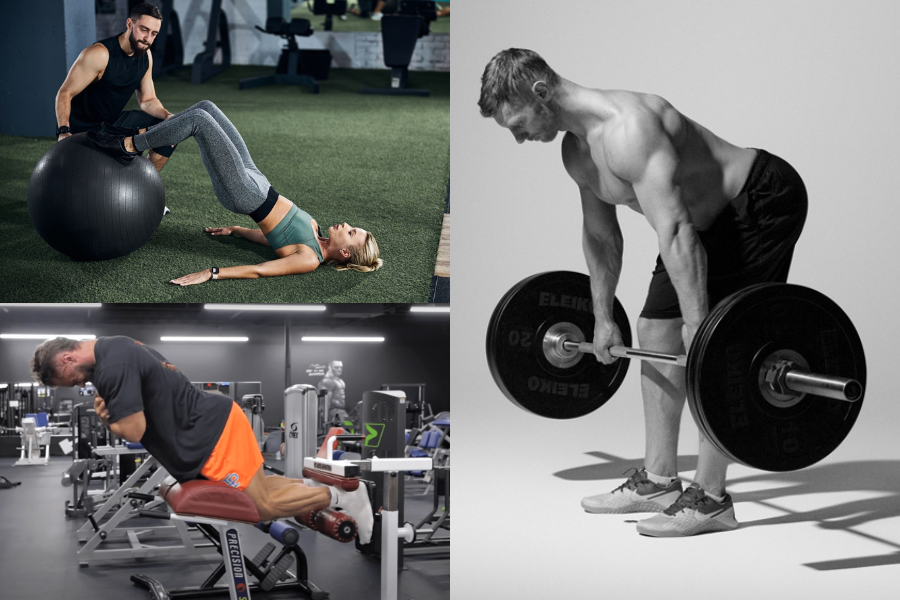
Physio ball leg curls
A stability ball adds an extra challenge for both your hamstrings and your core.
- Lie on your back and place your heels on top of the ball.
- Lift your hips so your body forms a straight line from shoulders to heels.
- Bend your knees to roll the ball toward your glutes.
- Slowly extend your legs to roll the ball back out.
The same setup can be used for a bridge where you simply hold the top position. Many rehab programs suggest 2 sets of 10 reps for both the leg curl and the bridge, with short rests.
Hamstring slides
Hamstring slides are a great home alternative to machine curls if you have a smooth floor and a towel or sliders.
- Lie on your back with knees bent and heels on sliders or a towel.
- Lift your hips slightly off the ground.
- Slowly slide your heels away from your body, extending your legs while keeping your hips up.
- Pull your heels back in, feeling the hamstrings work hard.
This is an advanced variation, so start with a small range of motion and 2 sets of 6 to 8 reps.
Eccentric focused hamstring exercises for injury prevention
Many hamstring injuries happen when the muscle is lengthening under load, such as during sprinting or powerful kicking. Eccentric exercises train your hamstrings in that exact situation, which is why they are a centerpiece of modern injury prevention programs.
Nordic hamstring curls
Nordic hamstring curls are one of the most studied exercises for reducing hamstring injury risk in athletes and runners. Studies repeatedly show that regular Nordic training significantly lowers hamstring injury rates, although you should expect some muscle soreness at first.
- Kneel on a padded surface with your torso upright.
- Anchor your feet under a sturdy object or have a partner hold your ankles.
- Brace your core and slowly lean your body forward from the knees, keeping your hips extended.
- Lower as far as you can control, then catch yourself with your hands and push lightly off the floor to return to the start.
In prevention programs, a common prescription is 3 sets of 5 to 8 slow reps, focusing on a 3 to 5 second lowering phase.
Single leg Romanian deadlifts
Single leg RDLs, sometimes called arabesques, improve hamstring strength and control on one side at a time. They also challenge your balance and hip stability, both of which matter for running and field sports.
- Stand on one leg with a gentle bend in the knee.
- Hinge at the hip, sending your free leg straight back as your torso leans forward.
- Keep your hips square to the floor and your back long.
- Return to standing by driving your planted foot into the ground.
You can start with bodyweight and then add a dumbbell or kettlebell in the opposite hand. Many programs recommend 3 sets of about 10 reps per leg.
Eccentric bridges
Eccentric bridges mimic what your hamstrings do during faster running, where they lengthen under load.
- Set up as you would for a basic glute bridge.
- Lift your hips quickly, then slowly lower them over 3 to 5 seconds.
- You can also perform this as a two leg lift and one leg slow lower.
Perform 2 to 3 sets of 8 to 12 reps, focusing on that deliberate lowering phase.
Hamstring exercises for runners and athletes
If you run, play soccer, rugby, or any sport that includes sprinting, your hamstrings work through several phases of each stride. They pull you forward at foot strike, help lift your heel during stance, and then stretch eccentrically to slow your knee at the end of the swing phase. During even a modest 30 minute run, this happens thousands of times.
For you, the best hamstring exercises will:
- Build eccentric strength
- Support sprint mechanics
- Fit around your running or practice schedule
A practical mix could include:
- Nordic curls for direct eccentric strength
- Single leg RDLs to support the stance phase and hip stability
- Romanian deadlifts or glute ham raises for overall posterior chain power
- Sprints at varying distances to turn strength into performance, since some strength coaches rank sprinting as an S+ tier hamstring exercise for contact athletes
Try placing your hamstring work after lighter running days or on strength focused days so you are not tackling heavy eccentrics after an all out sprint session.
How often to train your hamstrings
The exact number of sets and sessions you need depends on your goals and other training, but research suggests that 10 to 16 total sets of hamstring work per week is a good target for most people who want both growth and protection from injury.
A simple structure might look like this:
- Two days per week with 4 to 6 total sets per day, or
- Three days per week with 3 to 5 total sets per day
For example, you might do:
- Day 1: Romanian deadlifts and leg curls
- Day 2: Glute bridges and single leg RDLs
- Day 3: Nordic curls and hamstring slides
Keep at least one day of rest between hard hamstring sessions, especially if you include very demanding exercises like Nordics or heavy RDLs.
Stretching and recovery for healthy hamstrings
Strength is a big part of hamstring health, but it is not the only piece. Gentle, regular stretching helps you maintain comfortable range of motion and can ease feelings of tightness.
Commonly recommended hamstring stretches include:
- Standing straight leg hamstring stretch, a simple forward fold with soft knees
- Downward Dog, which lengthens the whole posterior chain
- Half kneeling hamstring stretch, with one knee down and the front leg extended
- Supine hamstring stretch, lying on your back and gently pulling one straight leg toward you with a strap or towel
Foam rolling the backs of your thighs can also ease muscle spasms and improve flexibility in a way similar to massage. You might start with 2 sets of about 20 seconds of rolling per side, with short rests.
If you have a history of hamstring injury, remember that re injuries are common, and about half of them happen in the first month after returning to sport. A longer term plan that combines eccentric strength work, progressive load, and adequate rest is your best friend.
You do not need a perfect program to benefit from hamstring training. Choose two or three of the best hamstring exercises in this guide that match your level and equipment, add them to your next lower body workout, and notice how your hips, knees, and stride feel over the next few weeks.
About the Author