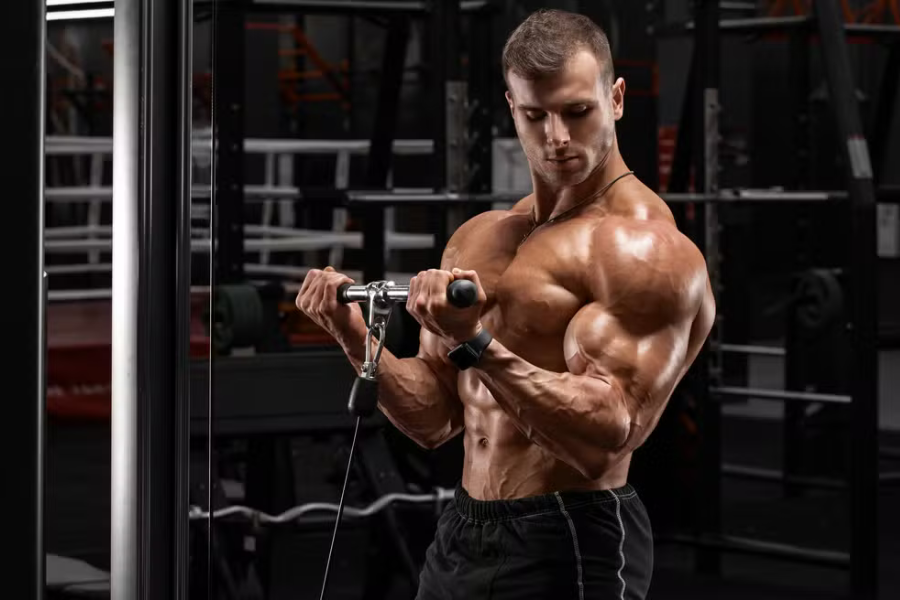
A well planned set of dumbbell bicep exercises can build noticeably stronger, more defined arms without needing a full gym. With just a pair of dumbbells and good form, you can hit every part of your biceps and supporting muscles, while protecting your joints and avoiding common mistakes.
Below, you will learn the best dumbbell bicep exercises, how to perform them step by step, and how to turn them into a simple workout for your current fitness level.
Why dumbbell bicep exercises work so well
Dumbbells are one of the most effective tools for training your biceps. They let each arm work independently, help correct strength imbalances, and give your joints a more natural range of motion than many bar variations.
You can rotate your wrists, change your arm path, and slightly adjust your elbow position to emphasize either the long or short head of the biceps, as well as the brachialis and brachioradialis. This versatility increases muscle activation and lets you tailor the movement to your body and goals.
According to the Mayo Clinic, the basic biceps curl with dumbbells is already a very effective way to strengthen the muscles at the front of your upper arm when you use slow, controlled reps and keep your elbow close to your body. From that simple base, you can build an entire biceps routine.
Master the classic dumbbell bicep curl
If you only did one bicep exercise with dumbbells, this would be it. The standing dumbbell curl targets both heads of the biceps and also trains the smaller muscles of your forearm that support gripping and elbow flexion.
How to do a standing dumbbell curl
- Stand tall with your feet about hip width apart. Hold a dumbbell in each hand at your sides, palms facing in.
- Brace your core, pull your shoulders slightly back, and keep your chest open.
- Start the curl by turning your palms up as you bend your elbows. Keep your elbows close to your torso and in front of your hips.
- Continue curling until your pinky fingers approach your shoulders, then squeeze your biceps at the top.
- Lower the weights slowly and under control, turning your palms back toward your thighs as you return to the start.
A slow tempo matters here. Jeff Cavaliere of Athlean X suggests taking around four seconds to lift and four seconds to lower the weight to maximize muscle activation and reduce injury risk, especially if you are prone to swinging or rushing your reps.
Form tips and common mistakes
You will get more out of lighter weights done well than heavier weights with sloppy form. Watch for these issues:
- Letting your elbows drift forward or backward too much
- Leaning back or using your lower back to start the movement
- Bouncing the weights or dropping them quickly
Maintaining a tall spine, tight core, and still upper arms keeps the tension where you want it, in your biceps, not your shoulders or lower back.
Train each arm with alternating curls
Alternating dumbbell curls give you a chance to focus on one arm at a time while still working both sides in the same set. This helps find and correct strength differences and can improve your mind muscle connection.
You can do traditional alternating curls or an alternating curl with an isometric hold.
Alternating curl with iso hold
The iso hold version helps keep constant tension on the biceps, which is useful for growth.
- Curl both dumbbells up to the halfway point.
- Hold one dumbbell in the top position while you lower and curl the other for one rep.
- Switch sides, holding the opposite arm at the top while the other arm moves.
- Continue alternating until you complete your reps.
This style demands control and focus and it quickly exposes if you are using too much weight, because you cannot hide behind momentum.
Isolate the biceps with concentration curls
Concentration curls are one of the best dumbbell bicep exercises for isolating the short head of the biceps and improving the peak of your upper arm.
Because your elbow is braced against your inner thigh, other muscles are less able to help, so your biceps do most of the work.
How to do a concentration curl
- Sit on a bench or sturdy chair with your feet flat and spread slightly.
- Hold a dumbbell in one hand and lean forward a little.
- Place the back of your upper arm against the inside of your thigh, just above the knee. Your arm should be almost straight, dumbbell hanging toward the floor.
- Keeping your upper arm fixed, curl the weight toward your shoulder while keeping your palm facing up.
- Squeeze at the top, then lower slowly until your arm is almost straight again.
Use lighter weights and focus on control. Aim for feeling the muscle rather than chasing big numbers. Research reviewed in 2024 highlighted that curls with a supinated grip, like this one, emphasize the short head of the biceps and are ideal for detailed work and hypertrophy.
Build thickness with hammer curls
Hammer curls look similar to standard curls but use a neutral grip, palms facing each other. This small change shifts more work to the brachialis and brachioradialis, muscles that sit underneath and around the biceps.
As these muscles grow, your upper arm looks thicker from the side and your grip strength improves, which is useful for sports and daily tasks.
How to do a hammer curl
- Stand or sit tall with a dumbbell in each hand at your sides, palms facing each other.
- Brace your core and keep your elbows close to your torso.
- Curl both dumbbells up while maintaining the neutral grip.
- Stop when the dumbbells reach about shoulder level, squeeze, then lower under control.
Hammer curls also reduce wrist strain for many people, since the neutral position is often more comfortable than full supination. They are a good choice if straight bar curls bother your wrists.
Stretch and hit the long head with incline curls
Incline dumbbell curls increase the stretch on the long head of the biceps, which contributes strongly to your biceps peak. Because you lean back, your shoulders cannot roll forward to help and cheating becomes much harder.
How to do an incline dumbbell curl
- Set an adjustable bench to about a 45 degree incline and sit back with your head and upper back supported.
- Let your arms hang straight down, palms facing forward, dumbbells in hand.
- Keeping your upper arms still, curl the weights up toward your shoulders.
- Pause briefly at the top, then lower very slowly until you feel a stretch at the bottom.
Use lighter weights than you use for standing curls. The stretched position is demanding and you want to maintain clean form along the full range of motion.
Try preacher curls for strict form
If you have access to a preacher bench, dumbbell preacher curls are an excellent way to isolate the biceps without the wrist discomfort some people get from a fixed bar.
Your upper arm is supported by the pad, which limits swinging, so most of the work falls directly on the biceps.
How to do a dumbbell preacher curl
- Sit at the preacher bench and rest the back of your upper arm on the angled pad.
- Hold a dumbbell with your palm facing up and let your arm extend almost fully.
- Curl the weight up until your forearm is vertical.
- Squeeze at the top, then slowly lower until your arm is nearly straight again.
Work in the 8 to 12 rep range with a controlled tempo. Focus on smooth movement and avoid bouncing at the bottom to protect your elbows.
Use wall curls to prevent cheating
If you find yourself leaning back or swinging to get the weight up, strict wall curls can help clean up your technique.
- Stand with your heels, glutes, upper back, and head lightly touching a wall.
- Hold dumbbells at your sides with palms facing forward.
- Keep the back of your upper arms close to the wall and curl without letting your shoulders roll or your lower back arch.
This variation limits momentum and forces your biceps to handle the majority of the load. It is demanding, so you may need to drop the weight a bit.
Advanced intensity techniques to try later
Once you have solid form and a base of strength, you can use advanced methods occasionally to increase intensity without adding more weight.
Purgatory reps
Purgatory reps alternate between full curls and isometric holds. For example, curl both dumbbells up, hold one at the halfway point while the other performs a full rep, then switch. This increases time under tension and can spark new growth when progress slows, as suggested by Jeff Cavaliere in his 2024 guidance.
Mechanical drop sets
Mechanical drop sets change the angle or style of the curl instead of lowering the weight. You might start with strict standing curls, then move to slight cheat curls, then finish with hammer curls, all with the same dumbbells.
This strategy lets you push your biceps past normal fatigue in a controlled way. Save these techniques for the last set of an exercise and avoid them if you are a beginner or still learning proper form.
Cheat reps with controlled negatives
Cheat reps involve using a bit of body English to help the weight up, then focusing on very slow, controlled lowering. This emphasizes the eccentric phase, where much of the muscle damage and growth signal happens.
These are an advanced tool. They are not recommended if you are new to lifting, have joint issues, or struggle to keep tension in your core.
Build a simple dumbbell bicep workout
You can create an effective routine by pairing 2 to 4 of the exercises above and adjusting based on your experience.
Here is one way to structure your training:
Start with 2 bicep exercises if you are a beginner. Add a third and fourth exercise only after your form and recovery are solid.
Beginner routine
- Standing dumbbell curls: 3 sets of 10 to 12 reps
- Concentration curls or preacher curls: 3 sets of 10 to 12 reps
Focus on smooth, controlled movement. Pick a weight that you can lift about 10 times with good form, where the last 2 or 3 reps feel very challenging, as recent training guidance suggests.
Intermediate routine
- Standing dumbbell curls: 3 to 4 sets of 8 to 12 reps
- Hammer curls: 3 sets of 8 to 12 reps
- Concentration curls: 3 sets of 10 to 12 reps
At this level you can begin to use occasional iso holds or slower negatives to increase difficulty without jumping straight to much heavier weights.
Advanced routine
- Incline dumbbell curls: 3 sets of 8 to 10 reps
- Standing dumbbell curls or strict wall curls: 3 sets of 8 to 10 reps
- Hammer curls: 3 sets of 10 to 12 reps
- Concentration or preacher curls: 2 to 3 sets of 12 to 15 reps
On your final set of one exercise, you might add a brief purgatory set or mechanical drop set to push the muscle safely beyond its usual fatigue.
Train biceps 1 to 2 times per week, depending on your overall program and how well you recover. Leave at least 48 hours between hard biceps sessions.
Safety tips and final pointers
Dumbbell bicep exercises are beginner friendly, but they still require care to protect your joints and back.
- Keep your wrists straight and firm instead of letting them bend backward, which the Mayo Clinic notes helps reduce elbow strain.
- Do not swing your torso or throw your hips forward. If you need momentum to start the rep, the weight is too heavy.
- Maintain a tight core and neutral spine to keep the load off your lower back.
- Control both the lifting and lowering phases. Rushing the negative part of the rep wastes one of the best opportunities for growth.
If you choose 2 or 3 of the exercises you have just learned and perform them with attention to detail, you will have a well rounded dumbbell bicep workout. Start with a weight that lets you move smoothly, focus on feeling your biceps working through each inch of the range of motion, and progress by adding a little weight or a few reps over time.
About the Author