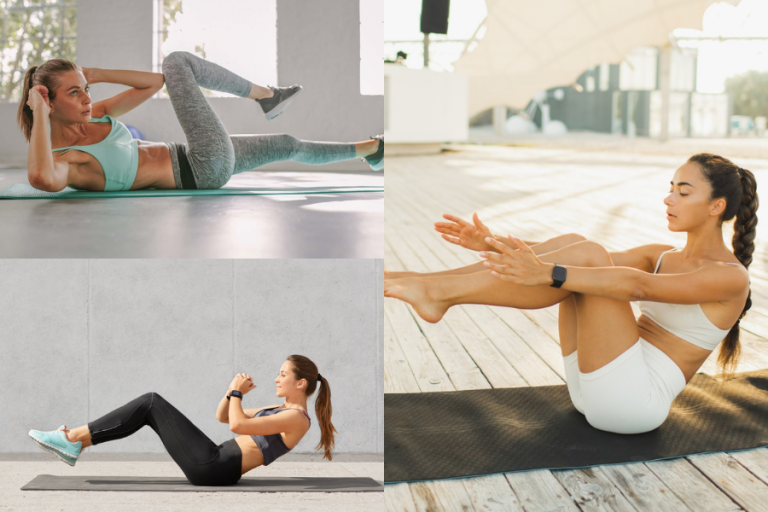
A plank ab workout is one of the simplest ways to build a strong, steady core without any equipment or complicated moves. With just your body weight and a few square feet of floor space, you can train your abs, obliques, hips, back, and even your arms and legs in a single routine.
Below, you will learn why planks are so effective, how to do them with safe, strong form, and how to put together a plank ab workout that fits your current fitness level.
Why a plank ab workout works so well
Unlike crunches, which only move your trunk in one direction, a plank ab workout trains your core to resist movement. This is what your abs actually do most of the day: stabilize your spine so your arms and legs can move freely.
Planks are an isometric exercise. That means you hold a position instead of moving through a big range of motion. When you plank correctly, you engage your:
- Rectus abdominis, the front “six-pack” muscles
- Transverse abdominis, the deep corset muscles that wrap around your midsection
- Internal and external obliques along the sides of your waist
- Hips and lower back, which help support the spine
You also recruit muscles in your shoulders, chest, arms, glutes, quads, and hamstrings, which is why fitness experts often describe planks as a total body exercise.
Some coaches even note that a focused 10 minute plank workout can deliver more effective core training than an hour of crunches, as long as you prioritize tension and good form over just holding on as long as possible.
Key benefits of plank-based core training
When you stick to a regular plank ab workout, you train far more than just your abs.
You can expect improvements in:
- Core strength: Because you are bracing against gravity, your core muscles learn to work together. This is the same bracing you use to pick up heavy items safely or perform squats and deadlifts with control.
- Posture: A strong core supports an upright spine and helps prevent slouching. Researchers have noted that planks build abdominal and back strength while being gentler on your spine than repeated crunches.
- Lower back comfort: Planks strengthen the stabilizing muscles around your lumbar spine without the repeated flexion that can aggravate some backs. Experts highlight planks as safer than sit ups for people with back concerns because they keep the spine relatively neutral.
- Balance and coordination: Variations that move one arm or leg at a time challenge your balance and improve the way your body controls movement in everyday life.
Since you need no equipment, planking is also convenient. You can drop to the floor for 5 to 10 minutes at home, in a hotel room, or next to your desk and still get meaningful strength work in.
How to hold a perfect basic plank
Before you build a plank ab workout, you need solid form. Good technique keeps your back safe and makes the exercise more effective.
Step by step forearm plank
- Lie on your stomach with legs extended behind you.
- Place your forearms on the floor with elbows directly under your shoulders and forearms parallel.
- Press into your forearms and lift your body so you are resting on your forearms and the balls of your feet.
- Form a straight line from your head to your heels. Avoid sagging at the hips or hiking your butt up.
- Gently tuck your tailbone, squeeze your glutes, and brace your abs as if someone is about to poke you in the stomach.
- Press your elbows into the floor and lightly squeeze your shoulder blades together to create upper back tension.
- Breathe steadily and hold.
Exercise specialists emphasize the importance of a neutral spine and active muscle engagement so that your core, not your joints, does the work.
Common form mistakes to avoid
It is easy to turn a great plank into a less effective hold if you rush your setup.
Watch out for:
- Hips sagging toward the floor, which compresses the lower back
- Butt lifted high so your body looks like an upside down V, which reduces core engagement
- Shoulders creeping up toward your ears
- Hands or elbows too far in front of the shoulders, which strains the shoulders and wrists
- Holding your breath
Think of “short and strong” planks rather than long, shaky ones. Many coaches recommend holding a tension filled plank for 30 to 60 seconds instead of chasing multi minute holds with poor alignment.
Beginner friendly plank ab workout
If you are new to planks or coming back from a break, start with a short, approachable routine two or three times per week. Focus on quality. When your form changes, stop and rest.
Here is a simple beginner plank ab workout:
- Knee forearm plank
- 3 sets of 20 to 30 seconds
- Rest 30 to 45 seconds between sets
- High plank on hands
- 3 sets of 15 to 25 seconds
- Rest 30 to 45 seconds between sets
- Side plank from knees, right side
- 2 sets of 15 to 20 seconds
- Rest 20 to 30 seconds
- Side plank from knees, left side
- 2 sets of 15 to 20 seconds
- Rest 20 to 30 seconds
Aim to complete this circuit 1 to 2 times per session. When you can hold each position with steady breathing and no discomfort for at least 30 seconds, you are ready for the next level.
Intermediate plank ab workout for all around core strength
Once you are comfortable with basic holds, you can expand your plank ab workout to hit your core from multiple angles. The routine below blends front, side, and dynamic planks.
Perform this circuit 2 to 3 times, resting 45 to 60 seconds between exercises:
- Forearm plank
- Hold for 30 to 45 seconds
- Keep shoulders over elbows and full body tension
- Side plank, right
- Hold for 25 to 40 seconds
- Stack your feet or place the top foot slightly in front for stability
- Side plank, left
- Hold for 25 to 40 seconds
- Plank with leg lift
- 8 to 10 leg lifts per side
- Start in a forearm or high plank, lift one leg a few inches without rocking your hips
- Straight arm plank with shoulder taps
- 10 to 16 taps total
- From a high plank, tap one hand to the opposite shoulder while keeping your hips as still as possible
Fitness professionals recommend starting with 4 plank exercises held for 30 to 60 seconds each, repeated three times, and then progressing to six variations as your capacity grows.
Advanced plank variations to try
If you have a strong core and good control, you can increase the challenge with more complex plank variations or added equipment. These moves are optional but useful if your current plank ab workout feels too easy.
You might experiment with:
- One arm full plank: Lift one hand off the floor and hold while resisting rotation.
- Star side plank: From a side plank, lift the top leg to form a star shape.
- Mountain climber pushup: Alternate driving knees toward your chest from a plank, sometimes combined with pushups.
- Plank push and pull with a weight plate: In a high plank, push and pull a weight plate across the floor to challenge your shoulders and core.
- Balancing planks on a stability ball or Bosu: Place your forearms or feet on an unstable surface to increase the demand on your stabilizers.
Many structured programs, such as 30 day plank challenges, use a new variation each day to build strength and keep things interesting. They typically aim for around 1 minute per variation, though you can shorten or lengthen that time based on your current level.
If you use equipment like medicine balls, sliders, or dumbbells, move slowly at first. Your goal is control, not speed.
How long you should hold your planks
There is no single perfect plank time that suits everyone. Instead, you can use a few practical guidelines.
Many coaches suggest:
- Beginners: Work up to 3 sets of 20 to 30 seconds with excellent form.
- Intermediate: Aim for 30 to 60 seconds per set.
- Advanced or endurance focused: Up to 90 to 120 seconds if you can maintain tension and alignment.
Exercise researchers point out that holding planks far beyond 60 to 90 seconds does not necessarily increase strength or muscle size in most people, since planks are isometric and do not move through a full range of motion. Instead of chasing extreme times, you will usually get more benefit by adding challenging variations, extra sets, or other core exercises.
If you feel your lower back, neck, or shoulders straining before your abs do, end the set. Over time, you will be able to hold tension for longer without discomfort.
Safety tips and when to modify
Planks are generally safe for most people, but like any exercise, they may need adjustment for your body.
You may want to modify or speak with a health professional before doing planks if you:
- Have an active shoulder, wrist, or elbow injury
- Experience ongoing low back pain, especially with weight bearing positions
- Have uncontrolled high blood pressure, since isometric holds can temporarily raise blood pressure
To make planks more accessible, you can:
- Elevate your hands on a sturdy bench or counter to reduce wrist and core load
- Drop your knees to the floor, while keeping a straight line from head to knees
- Shorten your hold times or do more sets of brief holds like 10 to 15 seconds
If you are unsure about your form, recording a short video or taking a photo from the side can help you spot any sagging or arching. Some experts even recommend this as a quick self check to keep your spine aligned and your joints comfortable.
Putting it all together
A focused plank ab workout does not need to be long or complicated to work. Two or three times per week, you can:
- Warm up lightly for 3 to 5 minutes with marching in place, hip circles, and arm swings.
- Choose 4 to 6 plank variations that match your level.
- Hold each one for 20 to 60 seconds, or perform 8 to 12 controlled reps if it is a dynamic plank.
- Rest 30 to 60 seconds between moves, then repeat the circuit 2 or 3 times.
As you get stronger, you can extend your holds slightly, add more challenging variations, or pair your plank ab workout with other strength exercises.
Try adding just one or two plank variations to your next workout and notice how your body feels. With consistent practice, you will likely feel steadier in daily life, more supported through your back, and more confident in your overall strength.
About the Author