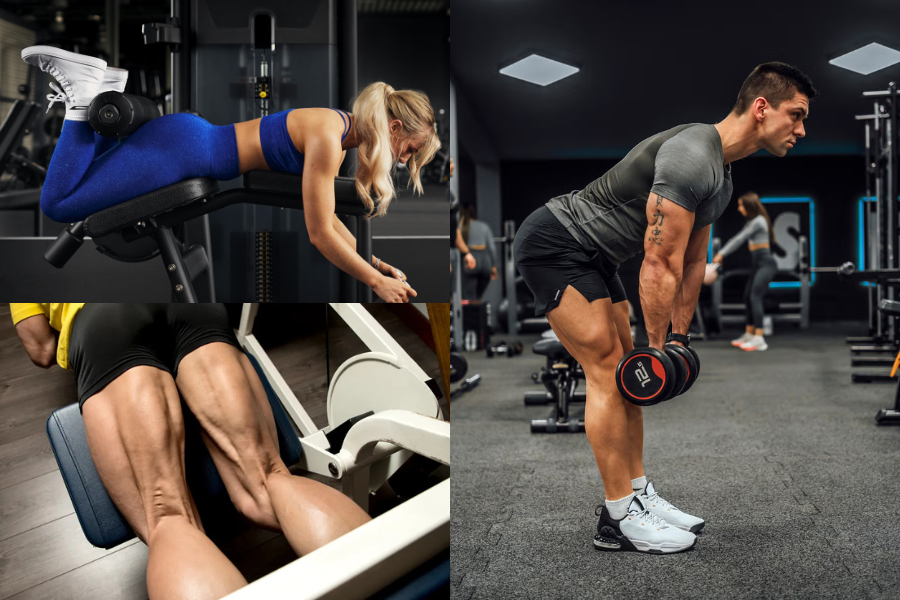
Hamstring muscle strengthening exercises do much more than sculpt the back of your legs. When your hamstrings are strong, you move better, protect your knees and lower back, and perform everyday tasks with less effort and fewer aches. If you run, lift weights, play sports, or just want fewer twinges when you stand up, learning how to train these muscles is worth your time.
Below, you will learn what your hamstrings actually do, how to tell if they are weak, and which hamstring muscle strengthening exercises give you the most benefit in the least time.
Understand what your hamstrings do
Your hamstrings are a group of three muscles on the back of each thigh: the biceps femoris, semitendinosus, and semimembranosus. Together, they bend your knee and extend your hip, which makes them key players in nearly every step, squat, or jump you take.
You use your hamstrings whenever you:
- Walk, run, or climb stairs
- Squat down to pick something up
- Tilt your pelvis to sit or stand
- Lean forward to wash dishes or tie your shoes
Strong hamstrings support your back as you hinge forward, help protect your knees and hips, and keep your gait smooth rather than wobbly or shuffling. Weakness, on the other hand, can contribute to low back pain, hip pain, knee instability, and even changes in how you walk, according to ACE Physical Therapy, LLC.
Spot the signs of weak hamstrings
You do not need fancy testing to suspect that your hamstrings need attention. A few everyday clues often show up first.
Common signs include:
- A dull ache under your buttock or along the back of your thigh
- Tightness when you bend forward, or needing to bend your knees to touch your toes
- Feeling unsteady when you run downhill or quickly change direction
- Hamstring strains that seem to return again and again
Physical therapist Julie Ann Aueron notes that decreased forward bending range of motion and persistent achiness at the back of the leg are key indicators of hamstring issues. If you recognize yourself in these descriptions, building strength gradually is usually a smart place to start.
Why strengthening your hamstrings matters
Your quadriceps, the large muscles on the front of your thighs, often get more attention than your hamstrings. Many people focus on squats, leg presses, and lunges that mostly target the front of the leg. Over time, this can create an imbalance where the quads dominate and the hamstrings lag behind.
Surrey Physio notes that this imbalance is common, especially in women, and can increase the risk of knee pain and muscle strains. When you bring your hamstrings up to speed, you help to:
- Reduce your risk of hamstring pulls and tears during running or sports
- Stabilize your knees and support your ACL, especially during cutting or pivoting
- Protect your lower back when you bend, lift, or carry groceries
- Improve performance in running, jumping, and squatting
Weak hamstrings are also identified as one of the leading causes of on‑field sports injuries, which is why coaches increasingly include hamstring strengthening in their training plans.
Think of your hamstrings as your built‑in shock absorbers. If they are strong and responsive, your joints take less of the impact from daily movement and sport.
Key principles for safe hamstring training
Before you jump into specific exercises, a few guidelines will help you strengthen your hamstrings without irritating them.
Focus on form first
Hamstring exercises only work if your hamstrings are actually doing the work. That means:
- Engaging your core to keep your spine neutral
- Squeezing your glutes so your hips do not tip forward
- Moving in a slow, controlled way instead of bouncing
If your low back starts to ache or your hips twist, reduce the weight or range of motion until you can maintain good alignment. ACE Physical Therapy notes that you can start with an incomplete range and gradually increase it as your control improves.
Progress gradually
Hamstrings tend to heal slowly when they are injured, so aggressive jumps in load can backfire. To stay on the safe side:
- Increase weight or band resistance in small steps
- Add repetitions only when current sets feel smooth
- Allow at least one rest day between hamstring‑focused sessions
A common recommendation is to train your hamstrings about twice per week, with at least 48 hours between sessions, performing up to 10 sets spread over 3 exercises and using a rep range of 6 to 20 depending on your goal.
Support your training with healthy habits
You will get more from your workouts if you pair them with smart recovery:
- Eat a balanced diet with fruits, vegetables, lean proteins, and whole grains to fuel muscle repair
- Maintain a healthy body weight to reduce unnecessary stress on your joints
- Sleep enough so that muscles can rebuild between sessions
These simple habits help your hamstrings respond better to training and reduce the risk of overuse injuries.
Best hamstring muscle strengthening exercises
There are many ways to work your hamstrings, and the best program for you depends on your equipment, experience, and injury history. Below are categories of effective hamstring muscle strengthening exercises, plus a few top moves in each group.
Classic weight‑room exercises
If you have access to a gym or free weights, these staples offer strong results.
Romanian deadlifts (RDLs)
Romanian deadlifts emphasize a hip hinge rather than a deep knee bend, which helps you load your hamstrings effectively. Surrey Physio recommends starting the bar around knee height and focusing on squeezing your shoulder blades at the top of each rep. A common starting point is 3 sets of 10 to 12 repetitions.
As you hinge, send your hips back, keep a soft bend in your knees, and feel a stretch along the back of your thighs. If you feel strain in your lower back instead, lighten the weight and shorten your range until your form improves.
Deadlifts and good mornings
Conventional deadlifts and good mornings also target your hamstrings along with your glutes and lower back. These compound lifts build total posterior chain strength, which carries over to day‑to‑day activities like lifting boxes or carrying laundry.
Leg curl machines
The prone (lying) leg curl machine is a classic hamstring isolation exercise. A 2018 University of Wisconsin–La Crosse study found that prone leg curls elicit relatively equal activation of both the biceps femoris and semitendinosus muscles in trained adults. That makes it a solid option if you want to hit both major hamstring heads efficiently.
The same study also identified seated leg curls as one of the most effective hamstring exercises for muscle activation, which is useful if lying prone is uncomfortable for your back or hips.
Bodyweight and Nordic‑style work
You do not need heavy equipment to challenge your hamstrings. Bodyweight exercises can be demanding, especially when you control the lowering phase.
Glute bridges and hip thrusts
Bridges and hip thrusts place you on your back with knees bent and feet on the floor. As you press through your heels to lift your hips, you work both glutes and hamstrings. You can progress from bodyweight to single‑leg variations or add a weight across your hips for more load.
Nordic hamstring curls
Nordic hamstring curls are intense, but they are also powerful for both strength and injury prevention. In a traditional setup, a partner holds your ankles while you lower your upper body toward the floor under control and then push back up. Research notes that Nordics heavily target the semitendinosus muscle, which plays an important role in stabilizing the knee and protecting the ACL, particularly after injury or reconstruction.
A simple starting protocol is 1 set of up to 10 controlled repetitions, possibly using your arms to catch yourself on a bench or the floor as you build strength.
Stability ball curls
Lying on your back with your heels on a stability ball and your hips lifted, you roll the ball toward you by bending your knees. This challenges your hamstrings while also testing your core stability. The 2018 electromyography study mentioned earlier found that stability ball hamstring curls can produce higher semitendinosus activation than prone leg curls, although they may provide somewhat lower biceps femoris activation overall.
Resistance band hamstring exercises
Resistance bands can simulate many machine‑based hamstring exercises for a fraction of the cost. Bands also offer constant, variable tension that increases as you stretch them, which means your hamstrings work harder at the top of each movement.
Common resistance band hamstring exercises include:
- Lying hamstring curls with a band anchored to a sturdy point and looped around your ankle
- Seated hamstring curls while sitting on a bench or chair
- Romanian deadlifts with a band under your feet and held in your hands
- Good mornings, glute bridges, and donkey kicks using hip bands
Band resistance can range from about 20 to 35 pounds for beginners up to 150 pounds for advanced users. This allows you to apply progressive overload, which is essential for muscle growth and strength gains over time.
A sample at‑home hamstring workout with bands might include band Romanian deadlifts, single‑leg glute bridges, banded hamstring marches, and lying hamstring curls, each for 2 to 3 sets of 8 to 15 reps with short rest periods.
Power and athletic moves
Once you have a base of strength, you can train your hamstrings to be not just strong, but powerful.
Kettlebell swings
Kettlebell swings require you to hinge at the hips, load your hamstrings, and then snap your hips forward explosively. The same 2018 University of Wisconsin–La Crosse study found that kettlebell swings produce similar hamstring activation to prone leg curls for both the biceps femoris and semitendinosus muscles, making them a time‑efficient choice that you can perform at home with a single kettlebell.
Single‑leg Romanian deadlifts
Single‑arm or single‑leg Romanian deadlifts challenge your balance and coordination along with your hamstrings. The 2018 study also highlighted these as highly effective for hamstring activation, comparable to prone leg curls. They are especially useful if you want to correct strength differences between your right and left sides.
Common mistakes to avoid with hamstring training
Hamstrings often stay weak not because people never train them, but because training quality is low. A few patterns show up again and again.
Giving hamstrings too little attention
Bodybuilders and recreational lifters alike sometimes give hamstrings fewer sets than smaller muscles like biceps, even though hamstrings carry more total muscle mass. A balanced lower body routine might include at least 12 dedicated sets for hamstrings each week, such as 4 sets each of Romanian deadlifts, lying leg curls, and seated leg curls.
Rushing through reps
Speeding through hamstring curls or deadlifts with a short range of motion reduces how much the muscle actually works. Better results come from:
- Lowering the weight or your body slowly
- Pausing briefly at the stretched position
- Squeezing fully at the top of the motion
Slowing your reps helps you feel the muscle you are targeting and encourages full stretches and contractions, especially if you also experiment with single‑leg variations.
Staying at the same weight forever
If every week looks identical, your hamstrings have no reason to adapt. You do not need advanced bodybuilding techniques, but you do need steady progression. This can mean:
- Adding a small amount of weight when sets feel easy
- Increasing reps within a range, such as from 8 to 12
- Moving to a more challenging variation, like from two‑leg to single‑leg bridges
Over time, this gradual overload leads to noticeable strength and muscle gains.
Putting it all together
You do not have to overhaul your entire workout to benefit from hamstring muscle strengthening exercises. You can begin with one or two moves and build from there. For example, you might start by adding Romanian deadlifts and glute bridges twice a week. Once those feel comfortable, you could introduce a banded hamstring curl or kettlebell swing.
Aim for consistency, not perfection. As your hamstrings grow stronger, you are likely to notice smoother movement, more confidence when you run or lift, and fewer nagging aches in your knees, hips, and lower back.
Choose one exercise from this guide to try in your next workout. Focus on slow, controlled reps, and pay attention to how your body feels during and after. Over the next few weeks, that small step can add up to a stronger, more resilient lower body.
About the Author