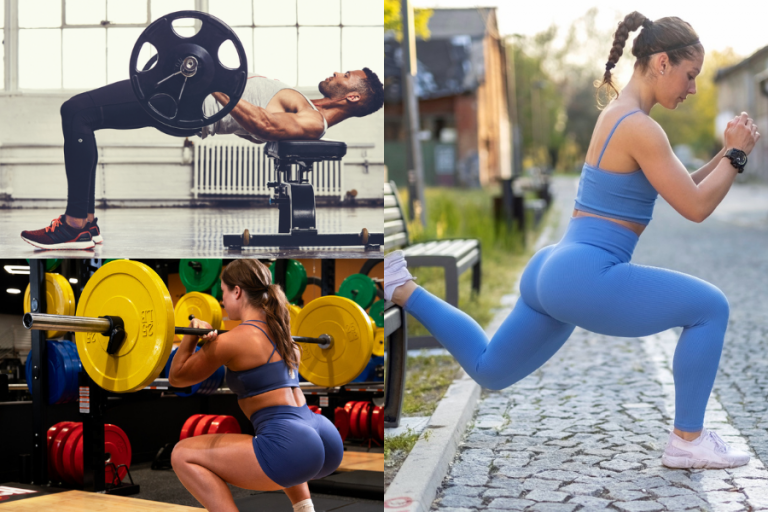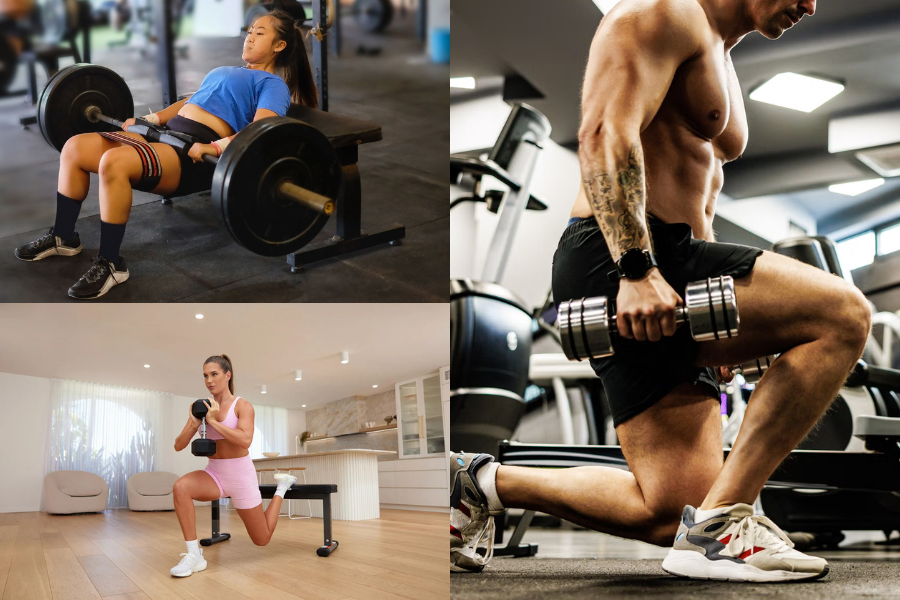
A solid glute workout routine can transform more than just how your jeans fit. Strong glutes support your lower back, improve your posture, and help you walk, run, and lift with more power and less pain. With a few focused sessions each week, you can build strength and muscle efficiently without living in the gym.
Below, you will find a clear plan that explains how your glutes work, how often to train, and exactly which exercises to prioritize at every level.
Understand your glute muscles
Before you start any glute workout routine, it helps to know what you are actually training. Your glutes are not just one muscle, they are a three-part team that shapes your hips and powers your lower body.
- Gluteus maximus is the largest muscle. It is responsible for hip extension, like when you stand up from a squat, climb stairs, or drive your hips up in a bridge or hip thrust.
- Gluteus medius sits on the side of your hip and helps with hip abduction and stabilization. It keeps your pelvis level when you walk or stand on one leg.
- Gluteus minimus is the smallest and lies under the medius. It helps stabilize the hip and supports smooth, controlled lower body movement.
Together, these muscles help you run faster, jump higher, and lift heavier, as highlighted by Gymshark in 2021. If you sit a lot or mostly do quad-focused exercises like leg presses and leg extensions, your glutes can become weak or “sleepy,” which can contribute to lower back pain and knee issues over time.
How often to train your glutes
For noticeable changes in strength and shape, consistency matters just as much as effort. Trainer Sandy Brockman recommends training the glutes three days per week as part of the Women’s Health Glute Gains Challenge, a six-week plan designed to build bigger, stronger glutes using science-backed methods. Each workout in that program lasts about 45 to 60 minutes and uses a barbell, dumbbells, and a bench or box, with modifications if you do not have access to a barbell.
Glute specialists such as Glute God also emphasize that training your glutes only once a week is usually not enough for growth. You want a schedule that gives you:
- 2 to 3 strength-focused sessions per week that include heavy compound lifts
- At least 1 rest day between heavy sessions so your muscles can recover and grow
- Light movement on non-lifting days, such as walking or mobility work, to keep blood flowing without overtaxing your body
If your legs are constantly sore or your performance dips for several workouts in a row, you may need more rest between heavy days. Adam Rosante, a certified personal trainer, suggests allowing two to three days of rest between heavy compound lifting sessions and adjusting if you notice your performance dropping.
Warm up and activate your glutes
Jumping right into heavy squats or hip thrusts without a warm-up is one of the most common glute workout mistakes. When you skip this step, your quadriceps and lower back tend to “take over,” which reduces glute activation and can raise your injury risk.
A simple warm-up should do two things: raise your heart rate and wake up the glute muscles.
-
General warm-up, 5 minutes
Try light cardio such as brisk walking, easy jogging, or cycling until you feel slightly warm and your breathing speeds up. -
Dynamic mobility, 3 to 5 minutes
Long periods of sitting can tighten your hip flexors and contribute to “glute amnesia,” where your glutes do not fire effectively. Glute God recommends dynamic stretches such as hip circles and leg swings to open your hips before training. -
Glute activation, 5 minutes
Use bodyweight or a light mini band. Gymshark advises exercises like lateral banded walks, banded glute bridges, and kickbacks to prime the glutes for heavier sets. Bootycamp-style programs begin every session with similar activation drills, such as band walks, clamshells, and pulses, to ensure your glutes are actually working during the main lifts.
During activation, focus on the mind-muscle connection. Squeeze your glutes through each rep and hold the contraction at the top for about one second. Research cited in the European Journal of Sports Science and discussed by Glute God in October 2025 suggests that this type of intentional contraction increases muscle activation and can improve gains over time.
Use the right rep ranges and loads
If your goal is to build stronger, more muscular glutes, you need a mix of heavy and moderate loads. Gymshark recommends:
- 8 to 12 reps per set at 60 to 80 percent of your one-repetition maximum (1RM) for hypertrophy
- Heavier sets of 5 reps at 80 to 90 percent of your 1RM for big compound lifts like hip thrusts or back squats
In practice, that means structuring your glute workout routine with a heavy “main lift” followed by several moderate-weight accessory exercises. You can also add lighter, higher-rep band work near the end of your session to fully fatigue the muscles.
Whatever weights you choose, keep progressive overload in mind. You can increase the challenge by:
- Adding more weight
- Doing more reps with the same weight
- Slowing your tempo to increase time under tension
- Shortening rest periods slightly between sets
Gymshark notes that tracking your sets, reps, and loads is useful so you are not lifting the same weight for months without progressing.
Best compound exercises for glute growth
Compound exercises train multiple muscle groups at once and are the cornerstone of an effective glute workout routine. They let you use heavier loads, which are important for building strength and size.
Gymshark identifies six top compound moves for the glutes: Barbell Hip Thrusts, Back Squats, Front Squats, Bulgarian Split Squats, Conventional Deadlifts, and Romanian Deadlifts. Research up to 2019 also shows very high gluteus maximus activation in many of these.
Barbell hip thrusts
Barbell hip thrusts are one of the most direct ways to load hip extension and target your gluteus maximus. A systematic review found that barbell hip thrust variations produce high GMax activation, from about 49.2 percent to 105 percent of maximal voluntary isometric contraction (MVIC), and that foot positioning with slight external rotation or hip abduction around 30 degrees can influence activation levels.
Even relatively low loads, such as 40 percent of your 1RM, can produce strong glute activation in this movement. Focus on driving through your heels, keeping your ribs down, and pausing briefly at the top to lock in the contraction.
Squat variations
Back squats and front squats both produce high glute activation, especially when you use a deeper range of motion. The research summary up to 2019 notes that activation can vary with bar position, stance, and depth, and that deeper squats may produce greater functional and hypertrophic benefits despite some differences in measured activation.
To emphasize your glutes more while squatting:
- Use a stance that feels stable, often slightly wider than shoulder width
- Sit your hips back as you descend, without collapsing your chest
- Aim for at least parallel depth if your mobility and form allow
Deadlifts and Romanian deadlifts
Traditional and hex-bar deadlifts, along with Romanian deadlifts, all elicit very high gluteus maximus activation. These hip hinge movements build posterior chain strength, improve posture, and help you generate power for running and jumping.
Keep the bar close to your body, hinge at the hips rather than rounding your back, and squeeze the glutes hard at the top without leaning backward. Start lighter than you think you need and build up as your technique improves.
Bulgarian split squats and lunges
Unilateral exercises such as Bulgarian split squats, split squats, and lunges challenge your balance and hip stability. They are particularly good for targeting the gluteus medius and minimus, in addition to the maximus.
Research shows that step-up style movements, including lateral, diagonal, and cross-over variations, can elicit extremely high glute activation, averaging over 125 percent MVIC due to the stabilization required during single-leg weight-bearing work. Bulgarian split squats and walking lunges offer similar unilateral benefits and should be regular features in your routine.
Isolation moves that target all three glutes
Compound lifts are essential, but they do not always hit every part of your glutes evenly. Isolation and lateral moves help you target the medius and minimus and fill in gaps that squats and deadlifts may miss.
Glute God recommends adding movements like:
- Banded side steps and lateral walks
- Clamshells
- Single-leg bridges or hip thrusts
- Cable or banded kickbacks
- Frog pumps
These exercises are especially useful near the start of your session as activation work and near the end as “finishers” to fully exhaust the muscles. Aim for higher reps, such as 12 to 20 per set, with a strong focus on feeling the glutes do the work instead of your lower back or quads.
Sample routines for every level
You can build a strong glute workout routine at home or in the gym, no matter your current level. Below are simple templates you can follow 2 or 3 times per week, with at least one rest day in between.
Beginner glute routine (no equipment required)
Great if you are new to strength training or coming back after a break.
- Warm-up: 5 minutes light cardio plus hip circles and leg swings
- Glute bridge, 3 sets of 10 to 12 reps
- Bodyweight squat, 3 sets of 10 to 12 reps
- Reverse lunge, 3 sets of 8 to 10 reps per leg
- Floor hip extension (on hands and knees), 3 sets of 12 reps per leg
- Optional finisher: 2 sets of 20-second glute bridges, holding at the top
These beginner moves focus on form and control so you can learn a strong hip hinge and keep your knees and back safe.
Intermediate glute routine (dumbbells or kettlebells)
Once bodyweight feels too easy, you can progress to intermediate exercises that use external load.
- Warm-up and activation: light cardio plus banded walks and banded glute bridges
- Bulgarian split squat, 3 sets of 8 to 10 reps per leg
- Sumo squat with kettlebell or dumbbell, 3 sets of 10 to 12 reps
- Single-leg glute bridge pulses, 3 sets of 12 to 15 reps per side
- Donkey kicks, 3 sets of 15 reps per leg
- Kettlebell swing, 3 sets of 12 to 15 reps
This routine improves strength, stability, and mobility, with an emphasis on a proper hip hinge on swings and squats.
Advanced glute routine (barbell and heavy lifting)
If you have lifting experience and access to more equipment, you can move up to heavier multi-joint movements.
- Warm-up: 5 minutes cardio, hip circles, leg swings, plus banded activation
- Barbell hip thrust, 4 to 5 sets of 5 to 8 reps
- Back squat or front squat, 3 to 4 sets of 6 to 8 reps
- Romanian deadlift or stiff-leg deadlift, 3 sets of 8 to 10 reps
- Barbell lunge or Bulgarian split squat, 3 sets of 8 reps per side
- Finisher: sliding leg curls or banded kickbacks, 2 to 3 sets of 15 to 20 reps
For added power and conditioning, you can occasionally include hill sprints on a separate day, which also challenge the glutes and hamstrings.
Common mistakes that slow your glute gains
If you have been doing glute workouts for a while but are not seeing results, a few small adjustments can make a big difference.
- Skipping activation. Starting heavy lifts without waking up your glutes lets your quads and back take over. Programs like Bootycamp fix this by always starting with drills like band walks and clamshells.
- Poor form and shallow range of motion. Half-rep squats, rushed deadlifts, and barely moving hip thrusts all reduce glute involvement and raise your injury risk. Slow down, use a weight you can control, and focus on full, safe range of motion.
- No progressive overload. Lifting the same weights for months teaches your body to maintain, not grow. Keep a simple log and regularly increase weight, reps, or time under tension.
- Training only heavy, never light. Glute God notes that heavy lifting without lighter activation and higher-rep band work can leave parts of the glutes undertrained. Include both.
- Ignoring recovery. Glute God recommends at least one rest day between heavy sessions plus active recovery options like walking, light yoga, or easy jogging. Without recovery, progress stalls and your injury risk goes up.
Pay attention to how your glutes feel during and after each workout. If you mostly feel your quads or lower back, adjust your stance, slow your tempo, and focus on squeezing your glutes on every rep.
Putting your glute plan into action
Strong, well-trained glutes do more than look good. They help maintain correct body alignment, protect your back, and provide the power you need for everyday tasks, from carrying groceries to walking or running uphill. If you spend a lot of time sitting, prioritizing glute work can be especially helpful for reducing discomfort and improving movement quality.
Choose one routine that matches your current level and commit to it three times per week for the next six weeks. Track your lifts, keep your warm-ups consistent, and focus on that one-second squeeze at the top of each rep. Over time, you will notice that not only do your glutes feel stronger, but your entire lower body moves with more stability and confidence.
About the Author