A treadmill and an elliptical can look almost identical from across the gym. Once you step on, though, they feel completely different. If you are comparing elliptical vs treadmill cardio for weight loss, joint health, and overall fitness, the best choice depends on your body and your goals.
Below, you will find clear, research‑backed guidance so you can pick the machine that fits your situation instead of guessing based on the calorie number on the screen.
Understand what each machine actually does
Both machines are designed for cardio, but they ask your body to move in different ways.
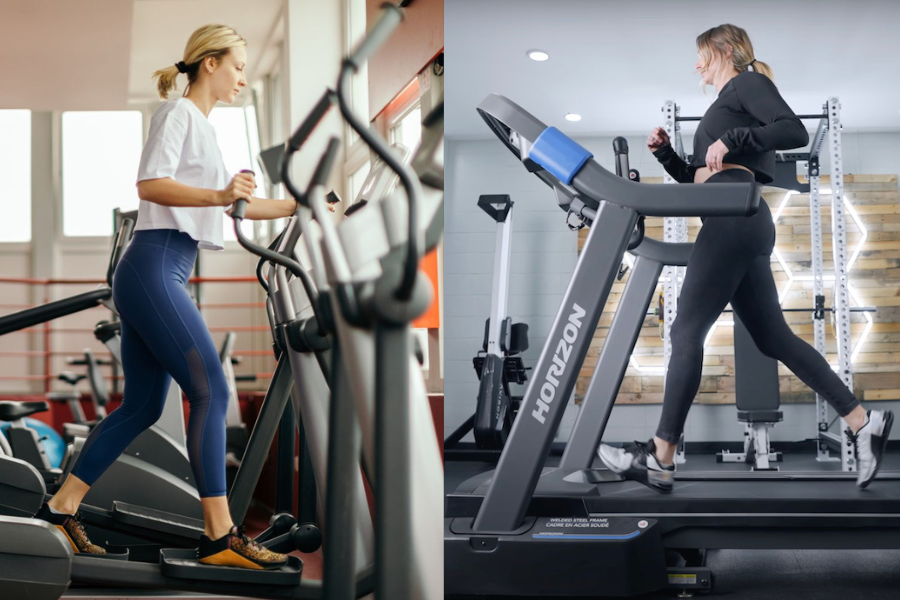
On a treadmill, you walk or run on a moving belt. Your feet leave the surface with every step, then land again. This impact loads your bones and joints in a similar way to outdoor walking or running. Treadmills also let you control speed and incline precisely, which is why they are popular for structured workouts and intervals. Treadmills are especially well suited to high intensity interval training that can quickly improve cardiovascular fitness and support fat loss (Healthline).
On an elliptical, your feet stay planted on the pedals while they glide in an oval path. You typically hold moving handles so your arms work in rhythm with your legs. Because your feet never leave the pedals, you avoid the pounding of running. Ellipticals are considered low impact and are often recommended if you have low‑back pain, arthritis, osteoporosis, or general joint sensitivity (Healthline, Nike).
In short, a treadmill mimics classic walking or running, while an elliptical gives you a smoother, more supported stride.
Compare calorie burn and weight loss potential
When you care about fat loss, you probably look first at how many calories you will burn in a workout. The catch is that the numbers on the machine screens can be misleading (HealthWellnessUS).
Several sources have compared elliptical vs treadmill cardio head to head:
- A 2010 study found that calories burned, oxygen consumption, and heart rate were nearly identical when people exercised at a similar effort level on an elliptical and a treadmill (Healthline).
- Harvard Health data summarized by Livefit reported that a 155 pound person burns about 335 calories in 30 minutes on an elliptical, compared with about 372 calories in 30 minutes of treadmill running at a 10 minute mile pace (Livefit).
So treadmills tend to burn slightly more calories in the same time, mainly because you must fully support your body weight and often recruit large muscles like your glutes and quads more intensely (Livefit, Nike).
However, that does not mean the treadmill always wins. Your actual calorie burn depends on:
- How hard you work, measured by breathing, heart rate, and perceived effort
- How long you stay on the machine
- Your body weight and current fitness level
- Whether you include intervals, incline, or resistance
Both machines let you adjust speed and incline or elevation, so you can easily turn a moderate session into a high calorie workout by adding intervals or hills (Livefit).
If you are more comfortable on one machine, you are likely to work harder and stay longer, which matters more for fat loss than small differences in calorie estimates.
Keep this in mind: consistent effort beats a theoretical 20 or 30 extra calories every half hour.
Protect your joints and prevent injuries
Your joints are often the deciding factor in the elliptical vs treadmill choice.
Impact and joint stress
On a treadmill, every step creates impact as your foot hits the belt. This can strengthen bones and may help support bone density and lower fracture risk over time, but it also increases stress on your knees, shins, and hips (Nike). Treadmill running and jogging have been linked to common overuse issues like shin splints, knee pain, and stress fractures, especially if you increase speed or distance too quickly (Healthline).
An elliptical avoids this pounding. Your feet stay on the pedals, so the movement is smoother and easier on your ankles, knees, hips, and back. This is why ellipticals are recommended for beginners, older adults, and anyone easing back into exercise after time off or injury (Livefit, NordicTrack, Nike).
Deeper look at joint mechanics
A 2024 study that directly compared pedaling motions similar to those on elliptical machines and stationary bikes found that elliptical style movement created higher peak forces at the knee and ankle at faster speeds (Medicina via PMC). Peak torque at the knee also happened later in the pedal stroke on elliptical type movement compared with stationary biking.
Elliptical style motion in that study led to internal rotation and inversion at the ankle, and the fixed pedal position limited how the ankle could move. That limitation meant the knee had to work harder to manage torque in the horizontal plane, especially at higher cadences (Medicina via PMC). The researchers recommended paying attention to pedaling speed and joint angles to reduce injury risk, and suggested that adjustable machine settings could help bring joint loads down.
For you, the takeaway is simple. Ellipticals are easier on your joints overall than running, but higher resistance or very fast strides can still stress your knees and ankles if your alignment is off. It helps to:
- Start at a moderate speed and resistance
- Keep your knees tracking over your toes
- Avoid locking your knees at the bottom of the movement
If you already have knee or hip issues, an elliptical is usually safer than a treadmill, but listening to your body still matters.
See how many muscles you work
You might also care about which muscles get the most benefit, especially if you want more than basic cardio.
Treadmill muscle focus
On a treadmill you mostly train your lower body. Walking and running recruit your quadriceps, hamstrings, calves, and glutes. If you add incline, your glutes and hamstrings work even harder, which can help build lower body strength and prepare you for outdoor hikes or races (Healthline, NordicTrack).
Your core also works to keep you upright and stable, especially if you avoid leaning on the handrails.
Elliptical muscle focus
Ellipticals give you a more obvious total body workout. The moving handles engage your arms, shoulders, chest, and back while your legs drive the pedals. Your glutes, hip flexors, and quadriceps all contribute, and many machines let you pedal backward to shift emphasis to slightly different muscle groups (Healthline, NordicTrack).
If you want to burn calories while lightly training your upper body at the same time, the elliptical has a clear advantage.
Match the machine to your goals
Once you understand the trade‑offs, it is easier to pick the best fit for your current priority.
If your main goal is weight loss
You can lose weight effectively with either elliptical or treadmill cardio. Both can produce similar heart rate, oxygen use, and calorie burn when you work at the same intensity (Healthline, Nike).
A treadmill may give you a slight edge in calorie burn per minute, especially if you run or use steeper inclines, but that only matters if you can handle the impact. If you find yourself skipping workouts because running hurts, switching to an elliptical will help you stay consistent, which is more important for fat loss.
Consider choosing:
- Treadmill if you enjoy walking or running and your joints tolerate impact
- Elliptical if you want low impact cardio that you can sustain several days per week
If your main goal is joint health
For sensitive knees, hips, ankles, or lower back, the elliptical is usually the safer option. Its low impact motion puts less stress on your joints, and it is commonly recommended for people with arthritis, osteoporosis, or musculoskeletal pain (Healthline, Nike).
You still get meaningful cardio benefits without the risk of pounding that comes with treadmill running. Just remember to keep resistance and speed reasonable so your joints do not have to handle excessive forces at extreme angles, something the 2024 pedaling study highlighted (Medicina via PMC).
If your main goal is performance
If you are training for a race or you want to improve your outdoor running, the treadmill is closer to the real thing. You can:
- Match your race pace
- Practice hill intervals
- Track speed and distance precisely
This level of control helps build specific endurance and pacing skills that transfer outdoors (Healthline, NordicTrack).
If you are not training for a race and you care more about overall health, an elliptical can match treadmill benefits in calories burned and heart health without the impact load (Nike).
Use intervals to boost results on either machine
No matter which machine you choose, you can get more out of your workouts by mixing steady state sessions with intervals.
High intensity interval training, where you alternate bursts of harder effort with easier recovery, works very well on both treadmills and ellipticals. Intervals can help you:
- Burn more calories during and after your workout
- Improve cardiovascular fitness faster
- Break up boredom
On a treadmill, intervals might look like alternating 1 minute of faster running with 2 minutes of brisk walking. On an elliptical, you could increase resistance or stride speed for 30 to 60 seconds, then return to an easier pace for 1 to 2 minutes. Research summaries note that HIIT on both machines can significantly increase calorie burn (Livefit).
Start with one interval session per week and build from there as your fitness improves.
Alternate both machines for long term progress
You also do not have to pick a single winner. Alternating elliptical vs treadmill cardio can keep workouts fresh and reduce overuse injuries.
NordicTrack notes that switching between machines helps:
- Engage slightly different muscle groups
- Avoid repetitive strain from doing the exact same motion every day
- Maintain motivation by changing your routine (NordicTrack)
For example, you might:
- Use the elliptical on days when your joints feel tired or you want a total body workout
- Use the treadmill on days when you feel energetic and want to push speed, distance, or incline
Over weeks and months, this variety can help you stay consistent, which is what drives lasting weight loss and cardio gains.
Key takeaways
Elliptical vs treadmill cardio is not about one machine being universally better. It is about what supports your body and your goals right now.
- If you want low impact, joint friendly cardio that still burns significant calories and works your upper and lower body together, choose the elliptical.
- If you want slightly higher calorie burn per minute and training that closely matches outdoor walking or running, choose the treadmill.
- For weight loss and heart health, both are effective as long as you work at a challenging but sustainable intensity and stay consistent over time.
Try a short workout on each machine this week, pay attention to how your joints and energy feel during and after, and let that experience guide where you spend most of your cardio time.
About the Author