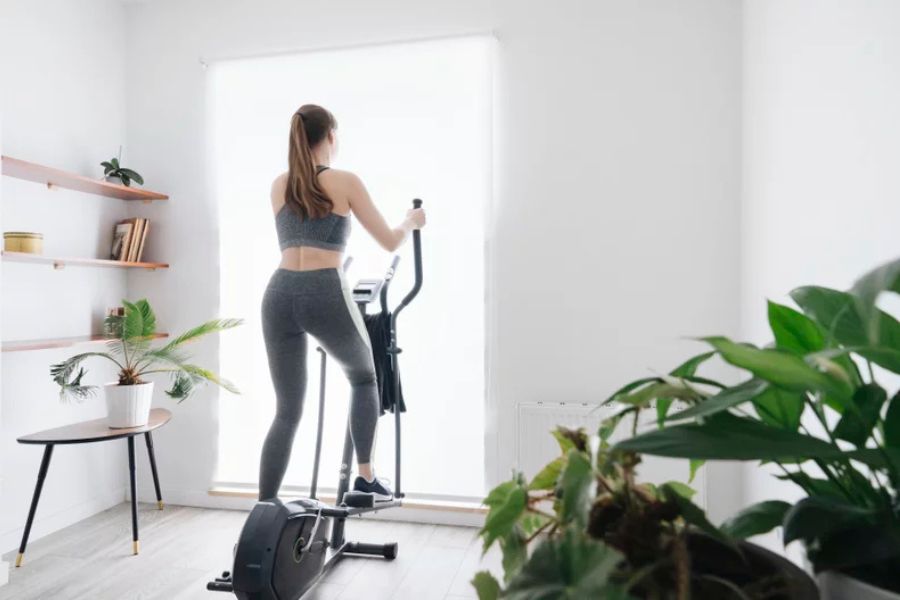
Elliptical machine exercises can reshape your body faster than you might expect, especially if you have joint pain or you are just getting back into fitness. By combining low impact movement with full body muscle engagement, the elliptical lets you burn calories, build strength, and protect your joints at the same time.
Below, you will see how elliptical machine exercises change your body, how to use the machine correctly, and a few sample workouts you can start this week.
Understand what elliptical workouts do for your body
When you step onto an elliptical and start moving, several changes begin happening inside your body at once.
You glide in a smooth circular motion instead of pounding the ground, so your knees, hips, and ankles feel less stress compared to running or jogging. Because your feet never leave the pedals, the movement is considered low impact, which is why ellipticals are often recommended for people with joint pain or those coming back from injury (Healthline, NordicTrack).
At the same time, you work a surprisingly large amount of muscle. Your lower body handles the pedaling, and if you use the moving handles you also involve your chest, back, shoulders, arms, and core (Healthline, CNET). Engaging more muscle groups increases the number of calories you burn and helps you build balanced strength.
A 30 minute elliptical session can burn roughly 270 to 400 calories depending on your weight, which is comparable to running on a treadmill (Healthline, Healthline). Over time, that calorie burn, combined with strength gains, leads to visible changes in your body.
Change 1: Stronger heart and lungs
Elliptical machine exercises are a form of aerobic or cardio training. As you pedal, your heart rate rises and your breathing deepens. When you stay at a moderate intensity where you feel slightly out of breath but can still talk, you strengthen your heart and lungs and improve overall stamina (Cleveland Clinic).
What you might notice
After a few weeks of regular workouts, you may find that:
- Climbing stairs or walking uphill feels easier
- You can work out longer before you feel tired
- Your recovery between intervals or workout days improves
Studies suggest that low impact cardio programs like elliptical training can improve cardiovascular fitness and body composition over time (Healthline). Put simply, you are training your heart like a muscle, and it responds by becoming more efficient.
Change 2: Less joint pain and better comfort
If running leaves your knees or hips aching, the elliptical is often a relief. Because your feet stay in contact with the pedals, your joints feel far less impact than they do on a treadmill or outdoor run (Healthline, Cleveland Clinic).
This makes elliptical machine exercises a smart option if you have:
- Arthritis or chronic joint pain
- A history of ankle or knee injuries
- Back discomfort that flares up with high impact activity
Many trainers and physical therapists use ellipticals to help people keep up their cardio fitness while they recover from injuries (NordicTrack). In other words, you still get the benefits of exercise without the extra wear and tear.
The one downside is that keeping your feet in the same position can sometimes cause temporary numbness or tingling. Shifting your weight and rolling through each pedal stroke helps reduce this (Garage Gym Reviews, CNET).
Change 3: Full body muscle toning
Elliptical machines work far more than just your legs. With proper form, you can turn every workout into a total body session.
Lower body
Each stride targets your:
- Glutes
- Quads
- Hamstrings
- Calves
Adjusting resistance and incline lets you shift the emphasis. Higher incline tends to recruit your glutes and hamstrings more, while higher resistance makes every push and pull more challenging (Healthline, CNET).
Pedaling backward can further light up your hamstrings and glutes since you are pulling through the stride instead of pushing (CNET, Healthline).
Upper body and core
If your elliptical has moving handles and you actually use them, you involve your:
- Chest and back
- Shoulders
- Biceps and triceps
- Core muscles
Coordinating your arm push and pull with your leg drive creates a more demanding workout and typically burns more calories than using the lower body alone (Healthline, Verywell Fit).
Over time, you may notice firmer legs, better posture, and more definition through your arms and shoulders, especially if you combine elliptical workouts with strength training.
Change 4: Fat loss and weight management
If your main goal is to lose weight, elliptical machine exercises can help you move toward that goal more quickly than casual walking.
A 30 minute elliptical workout can burn around 270 to 400 calories depending on your current weight (Healthline), and a similar range of 270 to 378 calories has been reported in other research (Garage Gym Reviews). The Cleveland Clinic notes that even at a more moderate pace, a 150 pound person may burn about 170 calories in 30 minutes, which still adds up when you are consistent (Cleveland Clinic).
The American Council on Exercise recommends at least 150 minutes of moderate activity per week for weight loss, which you can reach with five 30 minute elliptical sessions or four 45 minute ones (Garage Gym Reviews). Pairing this with strength training helps improve body composition so you lose fat while maintaining or building muscle.
High intensity interval training, or HIIT, on the elliptical can speed up results. Short bursts of hard effort followed by easier recovery periods let you burn more calories in less time while still keeping impact low on your joints (Garage Gym Reviews, Cleveland Clinic).
Use correct form so you see results faster
Good technique helps you get more from your elliptical workout and reduces your risk of aches and pains.
Posture and alignment
Stand tall with your shoulders down and back, chest open, and eyes forward. Avoid leaning heavily on the handles. Lightly hold them and let your legs and core do the work instead (CNET).
Place your entire foot on the pedal and distribute your weight evenly. Roll through the pedal stroke instead of staying up on your toes, which helps protect your knees and reduces numbness (CNET).
Handle use and core engagement
During warm up, cooldown, and easier intervals, try letting go of the handles. This challenges your balance and forces your core to stabilize you. You can then grip the handles again during harder work intervals to involve the upper body more and increase intensity (Lose It!).
Wear supportive running shoes or cross trainers with good arch support and cushioning so your feet stay comfortable through longer sessions (Lose It!).
Start with the right intensity and duration
If you are new to exercise or returning after a break, starting slowly is important.
Guides for beginners recommend workouts as short as 10 minutes at first. This gives your muscles and joints time to adapt while you practice form (Verywell Fit). Over several weeks, you can build up to 20 or 30 minutes and eventually beyond.
Using a simple 1 to 10 effort scale, known as Rate of Perceived Exertion (RPE), can help you monitor intensity. For fat loss and general fitness, you will usually spend most of your time around a 4 to 6, which feels easy to moderate (Verywell Fit).
Try these sample elliptical workouts
You can adjust the exact resistance and incline settings to match your machine and fitness level. The key is how each phase feels.
Aim to warm up and cool down for at least 3 to 5 minutes every time you use the elliptical, even for very short workouts.
15 minute beginner workout
Inspired by beginner routines that focus on gradual progression (Garage Gym Reviews, Verywell Fit):
- Minutes 0 to 3: Easy effort, low resistance, no incline, focus on posture
- Minutes 3 to 5: Lightly increase resistance to reach an RPE of about 4
- Minutes 5 to 10: Stay at a comfortable, steady pace you can maintain
- Minutes 10 to 12: Increase resistance one level, RPE 5 to 6
- Minutes 12 to 15: Reduce resistance and slow your pace to cool down
Use this session a few times per week until 15 minutes feels manageable, then add 2 to 5 minutes at a time.
30 minute interval workout for fat loss
Based on common interval approaches that combine moderate and hard efforts (Garage Gym Reviews, Lose It!):
- 5 minutes easy warm up, RPE 3 to 4
- 2 minutes at higher resistance, RPE 7, push with arms and legs
- 3 minutes at lower resistance, RPE 4 to 5, recover
- Repeat the 2 minute hard and 3 minute easy pattern four times
- 5 minutes easy cooldown, maybe let go of the handles and focus on balance
This structure gives you 8 minutes of fairly intense work in a 30 minute block, which can improve cardiorespiratory fitness and burn more calories than staying at one pace (Cleveland Clinic).
4 minute Tabata style finisher
If you are short on time or want a quick finisher after strength training, a brief, intense protocol can work well.
A Tabata style elliptical session uses 20 seconds of very hard work followed by 10 seconds of rest, repeated for 8 rounds, for a total of 4 minutes (Garage Gym Reviews). You should already be warmed up before you start and comfortable with higher intensities.
Because this is demanding, use it no more than a couple of times per week and listen to your body.
Make elliptical training part of a bigger plan
Elliptical machine exercises can change your body quickly when you use them consistently and pair them with healthy habits.
For best results, aim to:
- Reach at least 150 minutes of moderate cardio per week
- Include 2 or more days of strength training to build muscle
- Adjust resistance and incline regularly so your body keeps adapting (CNET, NordicTrack)
Start with one change today. That might be a 10 minute easy session on the elliptical or a simple interval workout where you gently push a little harder than usual. Over the next few weeks, you will likely notice you are breathing easier, moving with less pain, and feeling more confident in your workouts.
About the Author