A strong set of calves does more than fill out your jeans. The best calf exercises help you run faster, jump higher, protect your ankles, and keep your lower legs resilient during everyday activities. With a little structure and consistency, you can train this stubborn muscle group effectively at home or in the gym.
Below, you will find the best calf exercises, how to do them with proper form, and how to turn them into a simple, effective workout.
Understand your calf muscles
Before you pick exercises, it helps to know what you are actually training. Your calves are mainly two muscles that work together every time you walk, run, or push off the ground.
Gastrocnemius vs soleus
The two primary muscles are:
- Gastrocnemius. This is the larger, more visible muscle that gives your calves their rounded shape. It crosses both your knee and ankle, and it is heavily involved in powerful movements like sprinting and jumping.
- Soleus. This flatter muscle sits underneath the gastrocnemius. It does a lot of the quiet, endurance work when you walk, stand for long periods, or run at an easy pace.
Both muscles contract through plantar flexion, which is the motion of pointing your toes and lifting your heels. Knee angle changes which one works harder. With a straight leg you bias the gastrocnemius, and with a bent knee you hit the soleus more. That is why a mix of standing and seated calf exercises is important for full development.
Best standing calf exercises
Standing variations are your primary tool if you want stronger, more defined calves that also perform well in sports. They emphasize the gastrocnemius and closely mimic how you use your calves in real life.
Bodyweight standing calf raise
If you are new to training or working out at home, this is your starting point.
- Stand tall with your feet hip width apart and your toes pointing straight ahead.
- Hold on to a wall, chair, or rail for balance if needed.
- Press through the balls of your feet and lift your heels as high as you comfortably can.
- Pause briefly at the top and squeeze your calves.
- Slowly lower your heels back down to the floor.
Keeping a straight back and straight knees is essential for proper form and for protecting your joints, as explained by experts at the Mayo Clinic. They also recommend smooth, controlled movements and a full range of motion to get the most out of each rep.
You can make this harder by doing single leg calf raises, where all of your weight is on one leg. This variation builds strength, balance, and helps you correct side to side differences.
Standing dumbbell calf raise
Once bodyweight feels easy, adding resistance with dumbbells is a natural next step. The dumbbell standing calf raise targets the gastrocnemius and also challenges your balance.
- Hold a dumbbell in each hand with your arms hanging at your sides.
- Stand with your feet shoulder width apart on a flat surface or on a low step with your heels just off the edge.
- Brace your core, keep your knees straight, and slowly rise up onto your toes.
- Hold the top position for a second while squeezing your calves.
- Lower your heels under control back to the starting position.
According to guidance from Nicole L. Campbell and Edward R. Laskowski, M.D., at Mayo Clinic, this version strengthens the calf muscles and helps protect the Achilles tendon, which can reduce the risk of lower leg injuries.
Eccentric step calf raise
Eccentric training focuses on the lowering phase of a movement. For your calves, this helps strengthen the muscles and tendons and may reduce the risk of strains.
- Stand on a step or sturdy platform with the balls of your feet on the edge and your heels hanging off.
- Use both feet to rise up onto your toes.
- Shift your weight onto one foot at the top.
- Slowly lower that heel down below the level of the step for a count of three to five seconds.
- Use both feet again to come back to the top, then repeat on the other side.
Physical therapists often use this kind of exercise to build eccentric strength in the calf muscles and the Achilles tendon, helping people tolerate rapid movements and sudden stops more safely.
Best seated and bent knee calf exercises
Because bent knees shift more work to the soleus, you need at least one seated or bent leg variation in your routine for complete calf development.
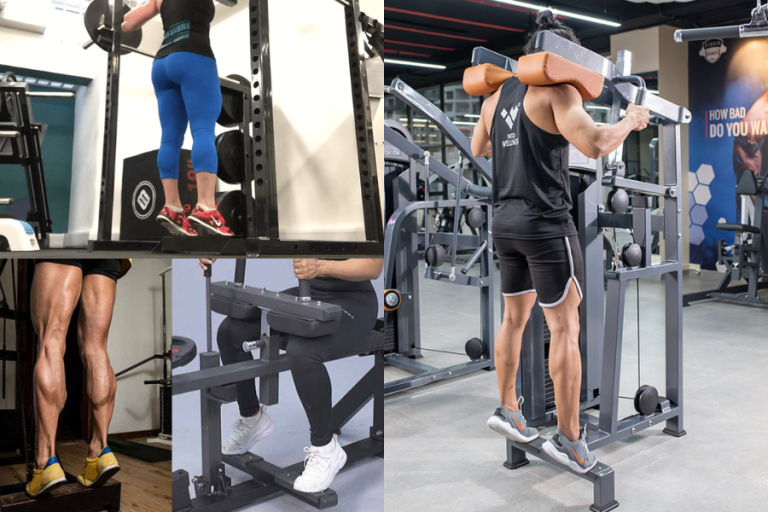
Seated calf raise
The classic seated calf raise isolates the soleus effectively. You can do it on a machine or improvise at home with dumbbells.
- Sit on a bench or chair with your knees bent at roughly 90 degrees.
- Place the balls of your feet on a block or plate so your heels can drop slightly below your toes.
- Rest dumbbells across your thighs close to the knees and hold them in place.
- Press through the balls of your feet to lift your heels as high as possible.
- Squeeze at the top, then lower your heels slowly and under control.
This version is especially useful if you prefer stability or you find balancing on one leg difficult. It also allows you to focus on slow, deliberate reps without worrying about tipping over.
Extended leg seated calf raise
If you straighten your knees while seated, the emphasis shifts back toward the gastrocnemius, which shows how simply changing your knee angle influences which part of the calf works harder. This is a helpful variation if you do not have access to standing calf raise equipment but still want to target both muscles.
Sit on the floor or a low bench with your legs stretched in front of you, wrap a resistance band or strap around the balls of your feet, and perform controlled plantar flexion by pushing against the band. Keep your knees straight the entire time for maximum effect.
Best dynamic and athletic calf exercises
Once you have a base of strength from calf raises, adding more dynamic movements will carry over directly to sports, running, and daily life. These exercises build power, coordination, and endurance.
Tiptoe walk
Walking on your tiptoes for distance or time is a simple way to challenge your calves and improve lower leg stability.
- Stand tall and rise onto the balls of your feet.
- Keep your heels elevated as you walk forward in a straight line.
- Move slowly and with control for 20 to 40 steps.
- Rest briefly, then repeat.
You can increase difficulty by holding light dumbbells at your sides. This variation is similar in spirit to a farmers carry, but it keeps your calves under constant tension.
Jump squats and lunge jumps
Plyometric moves like jump squats and lunge jumps train the calves as part of an explosive chain that includes your hips, thighs, and core. They are useful if you play sports that require quick changes of direction or powerful jumps.
For a basic jump squat:
- Stand with feet shoulder width apart.
- Lower into a squat with your chest up.
- Drive through your feet, including your calves, to jump straight up.
- Land softly by bending your knees and hips, then repeat.
Use a low to moderate volume and plenty of rest at first to avoid overloading your calves and Achilles tendon.
Foot position and form tips
Little changes in technique make a big difference in how your calves look and feel. The main variables are foot angle, tempo, and range of motion.
Target different areas with foot angle
Rotating your feet slightly changes which part of the gastrocnemius you emphasize:
- Toes pointing outward tend to hit the inner (medial) head more.
- Toes pointing inward tend to hit the outer (lateral) head more.
- Toes pointing forward share the load between both heads.
Across a week of training, you can rotate through these positions so you do not overwork the same fibers every time.
Prioritize control over weight
Regardless of which calf raise you choose, slower and more controlled usually beats heavier and rushed. Many coaches suggest:
- A full pause and squeeze at the top.
- A smooth lowering phase that is at least as long as the way up.
- Heels dropping slightly below the level of your toes, if your mobility allows, to train a full range of motion.
This approach lines up with expert advice that controlled movements and full range of motion improve effectiveness and minimize injury risk.
Sample calf workout plan
Here is a simple way to combine the best calf exercises into a balanced routine. You can add this at the end of a leg day or pair it with a short cardio session.
Aim to train your calves 2 or 3 times per week with at least one rest day in between sessions so the muscles and tendons have time to recover.
Workout A (focus on standing strength)
- Standing dumbbell calf raise, 3 to 4 sets of 10 to 15 reps
- Single leg eccentric step calf raise, 2 to 3 sets of 8 to 10 reps per leg
- Tiptoe walk, 2 sets of 20 to 40 steps
Workout B (focus on bent knee and power)
- Seated calf raise, 3 to 4 sets of 12 to 20 reps
- Extended leg seated calf raise with band, 2 sets of 15 to 20 reps
- Jump squats or lunge jumps, 2 to 3 sets of 6 to 10 reps
If your calves are slow to grow, they often respond better to higher repetition, lower load training performed with high effort, rather than only doing a few heavy reps. Just increase volume gradually and pay attention to any signs of excessive soreness in your Achilles or lower leg.
Warm up, stretch, and recover your calves
Strong calves are only useful if they are also healthy. A little preparation and recovery goes a long way toward preventing tightness and strain.
Warm up before you train
Dynamic warm up drills help prepare your calves for work by increasing blood flow and rehearsing the movement patterns you are about to use. Useful options include:
- Leg swings
- Walking lunges
- High knees
These dynamic stretches activate and mobilize both your calves and hamstrings before activity, which can reduce the risk of strains.
Stretch and release tight calves
After training or at the end of the day, regular stretching helps maintain calf flexibility. Simple choices like the wall calf stretch and foam rolling your calves for short intervals can reduce stiffness and support better muscle function and recovery.
It also helps to watch for early signs of overtraining, like persistent soreness or tightness that does not improve with rest. Building in at least one or two lighter days each week lets your calves adapt and come back stronger.
Putting it all together
If you want stronger, more defined lower legs, the best calf exercises are the ones you will actually do consistently. Mix a standing variation, a seated or bent knee variation, and one dynamic drill in each session. Rotate your foot position, move with control, and give your calves time to recover between workouts.
Start with manageable sets and reps, pay attention to how your body feels, and build up gradually. Over time, you will notice not only more muscle definition, but also better performance whenever you walk, run, jump, or simply stand on your feet all day.
About the Author