A strong, pain‑free back is less about heroic gym sessions and more about a few smart movements you do consistently. The best back exercises help you build muscle, support your spine, and improve posture so everyday tasks feel easier, not harder.
Below, you will find a practical guide to the best back exercises for strength and pain‑free living, whether you train at home with no equipment or in a fully stocked gym.
Why back exercises matter for pain‑free living
Your back is part of your entire “posterior chain,” which includes your glutes, hamstrings, and even your calves. When these muscles are strong and coordinated, they share the workload and protect your spine.
According to orthopedic surgeon Matthew Wert, M.D., maintaining a strong back is crucial for functional movement and preventing injuries at every age and activity level. If you sit a lot, have old aches that flare up, or simply want better posture, strengthening your back is one of the best investments you can make.
You also need balance. Many workouts focus on push movements like pushups, but without pulling and back work, your shoulders can round forward and your neck and lower back have to compensate. That is a recipe for stiffness and pain over time.
Best bodyweight back exercises at home
You can start building your back without a single weight. These bodyweight moves are especially useful if you are easing into exercise or protecting a sensitive back.
Superman and variations
The classic Superman and its variations target your spinal erectors, mid‑back, and even your glutes.
How to do a basic Superman:
Lie face down, arms extended in front of you and legs straight. Gently lift your chest, arms, and legs a few inches off the floor, pause, then lower with control. Keep your neck neutral by looking at the floor.
You can change your arm position to shift the emphasis:
- Y Superman: Arms overhead in a wide Y shape to hit upper back and shoulders.
- T Superman: Arms straight out to the sides to focus more on mid‑back.
- W Superman: Bend your elbows close to your sides to engage the muscles that help with posture.
Aim for 3 sets of 12 to 15 controlled reps for each variation that feels good for you. These are small, precise movements, not big throws of your body.
Reverse snow angels
Reverse Snow Angels look simple but give your upper back a deep challenge. They are also one of the best back exercises when you have no equipment available.
Lie face down with your arms at your sides, palms down. Lift your chest slightly, then sweep your arms out and up in a wide arc as if making a snow angel, ending with your hands overhead. Keep your thumbs pointing up and squeeze your shoulder blades together. Reverse the motion to return.
Start with 3 sets of 5 slow, deliberate reps. Focus on smooth movement and shoulder blade control rather than speed.
Hip hinge (Good mornings)
The Hip Hinge, often called a bodyweight Good Morning, trains your back to stay stable while your hips move, which is exactly what you want for daily life.
Stand with feet hip‑width apart, hands lightly behind your head or crossed on your chest. Soften your knees. Push your hips back as you lean your torso forward, keeping your back flat and core braced. Stop when you feel a stretch in your hamstrings, then return to standing by driving your hips forward.
Because this move teaches essential mechanics, it deserves your full attention. Try 3 sets of 10 to 15 reps and keep the motion pain‑free and controlled.
Nose and toes against the wall
This is an advanced bodyweight back and core exercise that looks like a wall‑supported handstand. It asks your entire back and midsection to work together.
Face a wall, place your hands on the floor, then walk your feet up the wall until your body forms a straight line, nose and toes close to the wall. Hold a hollow body position by gently tucking your ribs down and squeezing your glutes.
Hold for 15 to 30 seconds if you are comfortable, rest, then repeat. Since this position loads your shoulders and back heavily, it is best to build up gradually and avoid it if you have shoulder or wrist issues.
Best pulling exercises for strength and size
Once you are comfortable with bodyweight basics, pulling exercises help you build a stronger, more muscular back.
Pullups and assisted pullups
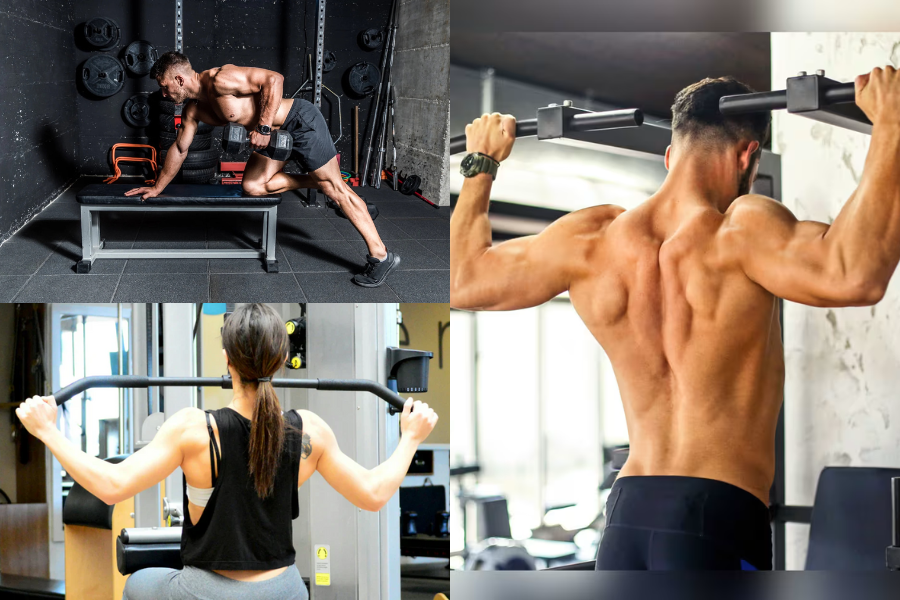
Pullups are often called the king of back exercises for a reason. Reddit users and coaches alike point out that they hit your lats, upper back, arms, and grip all at once, making them an efficient choice for building both strength and size.
Hang from a bar with your hands slightly wider than shoulder‑width, palms facing away. Pull your chest toward the bar by driving your elbows down and back, then lower with control.
If you cannot do a full pullup yet, use an assisted pullup machine, bands, or a partner to support some of your weight. You can also start with controlled negatives: jump or step up to the top position and lower yourself slowly.
Aim for 3 to 4 sets of 6 to 10 reps if you are using assistance, or smaller sets of quality reps if you are working toward your first unassisted pullup.
Inverted rows
Inverted rows provide horizontal pulling that complements the vertical pull of a pullup. You can do them using a sturdy bar, TRX straps, or a Smith machine.
Set the bar around waist height. Lie under it and grab it with an overhand grip, hands a bit wider than shoulder‑width. Keep your body in a straight line from head to heels and pull your chest up to the bar, then lower slowly.
Start with 3 sets of 8 to 10 reps. If it feels too easy, move your feet forward or lower the bar to increase the difficulty.
TRX or suspension rows
If you have access to TRX or another suspension system, you can perform rows with a big range of motion and fine‑tuned difficulty. TRX rows are especially useful for learning to engage your back without relying on momentum.
Stand facing the anchor point holding the handles, lean back, and walk your feet forward to increase the angle. Pull your chest toward your hands by driving your elbows past your ribs, then control the descent.
Try 3 sets of 8 to 10 reps, focusing on a strong squeeze between your shoulder blades at the top.
Best dumbbell and barbell back exercises
When you add weights, you can build more muscle and further support your posture and spine. These are classic strength training moves recommended for both beginners and advanced lifters.
Deadlifts for total backside strength
The deadlift is a cornerstone lift that trains nearly your entire posterior chain: upper traps, lats, spinal erectors, glutes, hamstrings, and even calves. It is one of the best back exercises for overall strength and muscle development.
Stand with feet about hip‑width apart, bar over mid‑foot. Hinge at the hips and bend your knees enough to grip the bar. Keep your chest up, back neutral, and core braced. Push the floor away to stand up tall with the bar, then lower it with the same path.
Because heavy deadlifts are demanding, they work best early in your workout if you are going under 6 reps. Always prioritize smooth form over load.
Bent‑over rows for thickness
The bent‑over row is a powerful builder for your lats, traps, upper and lower back. It pairs well with deadlifts or can be a main event on its own.
Hold a barbell with an overhand or underhand grip, hinge forward so your torso is about 45 degrees to the floor, and keep your back flat. Pull the bar toward your lower ribs, squeezing your shoulder blades together, then lower under control.
For most lifters, 3 to 4 sets of 6 to 10 reps near the start of your back workout works well. Use a weight that challenges you without forcing you to round your back.
Chest‑supported rows for safer heavy work
Chest‑supported rows, whether with dumbbells, a T‑bar machine, or a specific bench, reduce the strain on your lower back and help you focus on pure pulling.
Lie face down on an incline bench, chest supported. Hold the handles or dumbbells with a neutral or overhand grip. Row the weight toward your body, pause briefly, then lower slowly.
Because your lower back is supported, these are ideal later in your workout or when you want to train hard without extra spinal load. Aim for 3 to 4 sets of 8 to 15 reps.
Best back exercises for posture and everyday comfort
Some of the best back exercises are not about heavy weights at all. They are simple positions and movements that teach your body to stack properly and take pressure off your spine.
Healthline highlights several exercises that improve posture and back strength, including planks, glute bridges, and yoga poses like Downward‑Facing Dog. Cleveland Clinic experts also recommend targeted moves like standing rows, wall angels, and pelvic tilts to reduce back and neck strain.
Planks and side planks
A strong core supports your back like an internal corset.
- High plank: From hands and toes, keep your body in a straight line, shoulders over wrists, and core braced.
- Side plank: Lie on your side, prop up on your forearm, and lift your hips so your body forms a straight line from head to feet.
Start with holds of 15 to 30 seconds, 2 to 3 times per side, and gradually increase.
Glute bridges
Glute bridges strengthen your glutes and relieve some load from your lower back. Healthline notes that stronger glutes can improve hip and pelvis alignment, which helps posture and may reduce back pain.
Lie on your back with knees bent and feet flat. Press through your heels to lift your hips until your body forms a straight line from knees to shoulders. Pause and squeeze your glutes, then lower slowly.
Begin with 5 reps per day and work your way up to 30 over time.
Standing band rows and shoulder blade squeezes
Cleveland Clinic recommends standing rows with resistance bands to strengthen your upper back and prevent your shoulders from rolling forward. Attach a band at chest height, grab both ends, and step back to create tension. Pull your hands toward your ribs, squeeze your shoulder blades, then release with control.
If you are sitting, you can do shoulder blade squeezes: sit tall, gently pull your shoulder blades together and down, hold for 5 seconds, then relax. Repeat 3 to 5 times, twice a day.
Wall angels and “pull your head back”
Wall angels help open your chest and mobilize your upper back. Stand against a wall, feet a few inches out, and press your lower back, upper back, and head gently against the wall. Raise your arms into a goalpost shape and slowly slide them up and down like making a snow angel.
The “pull your head back” exercise is another Cleveland Clinic tip. While sitting or standing, gently retract your chin backward, as if you are making a double chin, without tilting your head up or down. This fights the common forward‑head posture that strains your neck and upper back.
Gentle back exercises when you already have pain
If you have back pain now, it is tempting to avoid movement completely. Yet NHS Inform points out that gradually returning to activity, including gentle back exercises, usually leads to better short and long term outcomes.
They recommend:
- Starting with 2 to 3 repetitions of simple moves a few times per day
- Increasing reps by 1 or 2 every few days
- Aiming for 2 sets of 15 reps over time
- Keeping pain levels in the 0 to 5 out of 10 range
Examples include knee‑to‑chest stretches, lower back rotational stretches, cat stretch, and pelvic tilts. Stretching is most effective when you hold positions for 20 to 30 seconds, 2 to 3 sets, 2 to 3 times a day.
If pain spikes during or after exercise, or you are unsure which movements are safe for your specific condition, talk with your doctor or a physical therapist before pushing further.
If you are new to strength training or unsure about your form, consider working with a personal trainer or physical therapist for a few sessions to build confidence and avoid accidental strain.
How to build your own back‑friendly routine
You do not need to perform every exercise in this guide. Instead, choose a mix that fits your current fitness level, your equipment, and your goals.
For example, you could build a simple, pain‑aware back routine like this:
- One hinge pattern: Hip hinge or light deadlift
- One vertical pull: Assisted pullups or lat pulldown
- One horizontal pull: Inverted rows or standing band rows
- One posture move: Wall angels or planks
- One gentle stretch: Cat stretch or knee‑to‑chest
Start with 1 to 2 sets of each exercise, focusing on smooth, pain‑free movement. Over the next few weeks, gradually add more reps, then another set, or slightly more resistance.
Consistency is the real secret. Soreness in the first week or two is normal, but your body will adapt as you keep showing up. With a small set of the best back exercises done regularly, you give yourself a strong foundation for pain‑free, confident movement in everything else you do.
About the Author