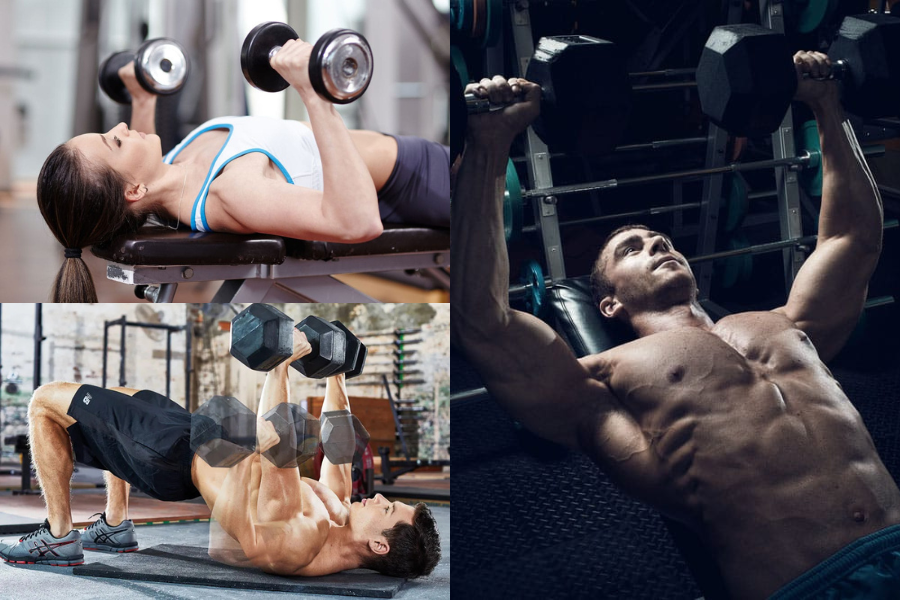
A focused chest workout with dumbbells can do much more than build bigger pecs. It can improve your posture, balance out strength imbalances, protect your shoulders, and make everyday movements feel easier. With just a pair of dumbbells and a bench or even a floor, you can train your entire chest effectively at home or in the gym.
Below, you will learn how a chest workout with dumbbells works, why it is so effective, and how to structure routines for every fitness level.
Why train your chest with dumbbells
A chest workout with dumbbells gives you benefits that barbells and machines cannot fully match. You are not just pushing weight. You are training stability, control, and balanced strength.
Compared to barbells, dumbbells allow your wrists to rotate and your elbows and shoulders to move in a way that feels natural. This freedom of movement places tension on your muscles instead of your joints, which can lead to more pec activation and better muscle growth over time. Because each arm moves independently, you also reduce left right asymmetries that are easy to hide when you use a bar.
You also get a larger range of motion than with most barbell or machine presses. You can lower the weights deeper for a better stretch on the chest, then press them up and actively squeeze your pecs at the top. That deeper stretch and stronger contraction can be a powerful combination for building size and strength.
Understanding your chest muscles
To get the most from your dumbbell chest exercises, it helps to know what you are actually training. Your chest is not just one flat muscle. It has several key parts that respond to different angles and movements.
- The pectoralis major is the largest chest muscle and is mainly responsible for moving and rotating your upper arms.
- The pectoralis minor sits underneath and helps stabilize your shoulder blades.
- The serratus anterior wraps around your ribs and helps rotate your shoulder blades so you can raise your arms overhead.
No single dumbbell exercise can fully target all areas of the chest at once. That is why a smart chest workout with dumbbells mixes movements that hit the upper, middle, and lower portions from different angles.
Key advantages of dumbbell chest training
The right chest workout with dumbbells can transform how your upper body looks and performs. Some of the most important benefits include:
- Increased muscle activation. The greater range of motion and ability to rotate your wrists lets you line up resistance with your chest fibers. This often leads to stronger contractions and more effective training of the pecs.
- Joint friendly training. Since your arms are not locked into a fixed path like on a machine or barbell, your shoulders, elbows, and wrists can move in positions that feel more comfortable. This may reduce strain and make it easier to train consistently, especially if you have nagging joint issues.
- Balanced strength and symmetry. Because each arm works independently, you cannot unconsciously let the stronger side take over. Over time, this helps correct muscular imbalances in your chest, shoulders, and arms.
- Better stability and core strength. Dumbbell presses require more stabilization than pressing a bar. Your shoulder stabilizers, abdominals, and even glutes have to work to keep you steady on the bench, which improves functional strength and control.
- Convenience and flexibility. Dumbbells are easy to find in almost any gym, and compact enough for home or travel. That makes it easier to stay consistent with your chest routine even when your schedule or location changes.
When you combine these advantages, you get more than a bigger chest. You build an upper body that is stronger, more balanced, and more resilient in everyday life.
Essential dumbbell chest exercises
A transformative chest workout with dumbbells does not require dozens of movements. It comes from choosing a handful of proven exercises and performing them with solid form.
Dumbbell bench press
The dumbbell bench press is one of the best chest exercises you can do. It builds strength and muscle, and the separate weights force each side of your body to work on its own.
Aim for 3 to 4 sets of 6 to 8 reps. Focus on keeping your forearms vertical over your elbows throughout the movement, and avoid flaring your elbows out too wide. If you move the dumbbells slightly forward on the way down and slightly back toward your shoulders on the way up, you better align the arm path with your chest fibers, which increases chest activation.
Avoid bending your forearms inward as you press. That shortens the lever, moves tension to your triceps, and takes stress off the chest, which can slow your progress. Keep your chest open and your shoulder blades lightly pinched together so the pecs, not the front of your shoulders, drive the movement.
Incline dumbbell press
If you want more upper chest development, the incline dumbbell press is essential. Setting the bench at a slight incline of about 15 to 30 degrees shifts the tension higher on your chest. Research shows that this can produce more than double the growth in the upper chest compared with a flat press. Angles higher than 30 degrees tend to pull work away from the chest and into the front delts, so keep the incline modest.
Perform 3 to 4 sets of 8 to 10 reps. Think about pressing up and slightly toward the midline of your body while you squeeze your chest at the top. Keep your core tight and your glutes lightly engaged so your body stays stable on the bench.
Dumbbell chest fly
The dumbbell chest fly is not about moving heavy weight. It is about adduction, or bringing your arms toward the midline, which your chest muscles are designed to do.
Start with light dumbbells and perform 3 sets of 10 to 12 reps. Lower the weights in a wide arc with a slight bend in your elbows until you feel a stretch across your chest, then bring them back up by squeezing your pecs, not your biceps or shoulders. At the top, imagine you are trying to hug a tree and hold the squeeze briefly for maximum activation.
Because the fly position places more stress on the shoulder joint, avoid dropping too deep or using jerky motions. Smooth, controlled reps are the goal here.
Floor press and single-arm variations
If a standard bench bothers your shoulders or you have wrist or elbow issues, the dumbbell floor press is a helpful option. Lying on the floor shortens the range of motion slightly and limits how far your elbows can travel. That reduces stress on the joints while still challenging your triceps, chest, and shoulders. It also recruits multiple muscles, which can elevate your heart rate and help you burn more calories.
You can also use a single-arm dumbbell press on a flat bench, incline, decline, or the floor. Pressing one weight at a time forces your core and stabilizers to work harder so you do not tip or twist. This is a powerful way to correct imbalances because your stronger side cannot assist your weaker side.
Perform 3 sets of 10 to 12 reps per arm, and keep your abs and glutes tight so your torso does not rotate.
Reverse grip and hex press options
If you are prone to shoulder irritation, small grip changes can make a big difference. The reverse grip dumbbell press uses an underhand grip with your palms facing your face. This position places your elbows closer to your sides, which reduces pressure on the shoulders and emphasizes the upper chest.
The hex press is another joint friendly option. You hold two hexagonal dumbbells together with a neutral grip, press them up while constantly pushing them toward each other, and bring them back down under control. This technique increases inner chest activation and pushing power while limiting external shoulder rotation.
Both variations can be used as second or third movements in your session to add more chest volume without overloading your joints.
Sample dumbbell chest workouts by level
You do not need complicated programming. What you need is a clear structure you can follow and progressively overload over time. Here is how you can build an effective chest workout with dumbbells at different experience levels.
A simple rule of thumb is to choose 2 to 4 exercises per chest session, start with heavier compound presses, and finish with lighter isolation work like flys or pullovers.
Beginner chest workout
If you are new to strength training or coming back after a break, start with basic patterns and focus on technique.
- Dumbbell bench press
3 sets of 8 to 10 reps - Incline dumbbell press
3 sets of 8 to 10 reps - Dumbbell chest fly
2 to 3 sets of 10 to 12 reps - Push ups
1 to 2 sets to comfortable fatigue
Rest 60 to 90 seconds between sets. Choose weights that allow you to complete your reps with good form while still feeling challenged on the last 2 reps of each set.
Intermediate superset workout
Once your form is solid, you can increase intensity by using supersets with minimal rest. This keeps your chest muscles under tension longer and can help spur new growth.
- Superset A
- Dumbbell bench press, 3 to 4 sets of 6 to 8 reps
- Dumbbell chest fly, 3 to 4 sets of 10 to 12 reps
Rest 60 seconds after each superset
- Superset B
- Incline dumbbell press, 3 sets of 8 to 10 reps
- Single-arm dumbbell press (flat or incline), 3 sets of 10 to 12 reps per side
Rest 60 to 90 seconds after each superset
Use weights that are challenging but still allow controlled movements. Since rest times are shorter, this style of training will test both your muscles and your conditioning.
Advanced burnout workout
If you are more experienced and want to push your chest workouts with dumbbells to the next level, you can combine heavy supersets with a final burnout phase.
- Superset A
- Dumbbell bench press, 4 sets of 6 to 8 reps
- Reverse grip dumbbell press, 4 sets of 8 to 10 reps
- Superset B
- Incline dumbbell press, 3 to 4 sets of 8 to 10 reps
- Dumbbell chest fly, 3 to 4 sets of 10 to 12 reps
- Five minute bodyweight burnout
Set a timer for 5 minutes and cycle through different push up variations with no rest. Start with standard push ups, then regress to incline or knee push ups as you fatigue. The goal is continuous work to muscular failure to drive hypertrophy and maximize results.
This final phase is demanding and may leave you very sore, so use it only when your recovery, sleep, and nutrition are in a good place.
How often to train and how to progress
For most people, training chest with dumbbells twice per week is ideal. This frequency gives your muscles enough stimulus to grow while allowing time to recover. If progress stalls after a while, you can increase to three sessions per week, as long as your joints feel good and your overall workload is manageable.
You can progress your chest workout with dumbbells in several simple ways:
- Add reps with the same weight, for example going from 8 to 10 reps over a few weeks.
- Add weight for the same reps, for example moving from 30 pound dumbbells to 35 pound dumbbells when you can complete all sets comfortably.
- Add an extra set to one or two key exercises.
Most effective chest training plans use 2 to 5 sets per exercise and rep ranges from 5 to 30 depending on your goal. Lower reps with heavier weights build maximal strength, while moderate to higher reps build muscle size and endurance.
If you stay consistent, you can usually feel improvements in performance in 3 to 4 weeks, such as more control, more reps, or more weight. Visible changes in chest size and shape typically appear within 8 to 12 weeks, assuming your nutrition supports your training and you recover well between sessions.
Form cues that protect your shoulders
Good technique is what turns any chest workout with dumbbells from risky into rewarding. A few key cues can help you train safely and effectively:
- Set your shoulders. Open your chest before lifting and lightly pinch your shoulder blades together. Keep this position so your chest, not your front shoulders, drives the press.
- Control the arm path. Avoid flaring your elbows out wide. Instead, keep them at a moderate angle to your torso and align your forearms vertically above your elbows.
- Engage your core and glutes. Lightly tightening your abs and squeezing your glutes turns your body into a stable base, which reduces strain on your shoulders and lower back.
- Squeeze at the top. On presses and flys, do not just move the weights. Actively contract your chest at the top of each rep for a brief second, then lower under control.
If any movement causes sharp pain, stop and adjust the angle, reduce the load, or choose a more joint friendly variation such as the floor press, reverse grip press, or hex press.
Putting it all together
When you build your routine around a smart chest workout with dumbbells, you are not only working on aesthetics. You are improving strength, joint health, symmetry, and stability in a way that carries into everything else you do.
Start by picking the level that fits your current fitness, focus on clean form, and progress gradually from week to week. With consistent effort, your chest will not be the only thing that transforms. Your confidence, posture, and overall performance will grow right along with it.
About the Author