A stationary bike might look simple, but the right workouts can turn it into one of the most powerful tools you have for weight loss, better health, and more energy. The best exercise bike workouts do not have to be long or complicated. Short intervals, smart pacing, and a little consistency are enough to move the needle for your fitness.
Below, you will find a mix of beginner friendly and challenging routines you can use on any upright, recumbent, or indoor cycling bike. You will also learn how to structure your week so you keep seeing progress without burning out.
Understand why exercise bike workouts work
Before you jump into intervals, it helps to know why these workouts are so effective for weight loss and health.
Indoor cycling is a low impact way to get your heart rate up and strengthen your legs. It is gentle on your joints, which makes it a good option if you are recovering from an injury or just getting back into exercise. When your bike is fitted properly, you can push yourself hard without the pounding that comes with running (SELF).
Calorie burn can be significant. Stationary bike workouts can burn more than 600 calories per hour, depending on your intensity and body weight (Healthline). Other estimates suggest that 30 minutes of moderate indoor cycling burns about 210 to 294 calories, while vigorous cycling can reach 315 to 441 calories in the same time frame (NordicTrack).
You also keep burning calories after you stop. One study found that 45 minutes of vigorous cycling burned over 500 calories during the ride and increased calorie burn by about 190 extra calories over the next 14 hours (NordicTrack).
In short, regular sessions on your exercise bike can:
- Improve cardiovascular fitness
- Help you lose weight and reduce body fat
- Lower cholesterol and triglycerides
- Build leg strength and endurance
If you aim for at least 150 minutes of moderate intensity exercise per week, which is the current recommendation for adults, you can meet that target with 30 minutes on your bike five days per week (NordicTrack).
Set up your bike for comfort and safety
The best exercise bike workouts start with proper setup. A good fit makes your ride more comfortable and helps you avoid knee, hip, or back pain.
If you are new to a particular bike, ask for a quick orientation or read the manual to learn how to adjust it. Beginners are encouraged to make sure the seat height, handlebar height, and seat distance from the handlebars feel natural so your knees are slightly bent at the bottom of each pedal stroke (Verywell Fit).
Before you begin, check these basics:
- Seat height: When you sit with your feet on the pedals, your leg should be almost straight at the bottom, but not locked.
- Seat distance: When a pedal is forward and level, your front knee should be roughly above the ball of your foot, not far ahead of it.
- Handlebar position: Adjust so you can reach comfortably without hunching your back or locking your elbows.
Comfort matters more than you might expect. Loose workout clothes, a towel, and a fan or open window can make longer rides feel manageable and even enjoyable. Feeling too hot or cramped can make you want to cut your workout short, so set up your space so you actually want to get on the bike (Powertrain).
Use effort levels instead of numbers
You can use heart rate zones, power, or RPMs if your bike has those metrics. If not, you can still get a great workout by using a simple 1 to 10 scale called Rate of Perceived Exertion, or RPE.
Indoor cycling coaches often group intensity into four levels (SELF):
- Easy (RPE 3 to 4): You can talk in full sentences and breathe comfortably.
- Moderate (RPE 5 to 6): You are breathing faster but can still hold a conversation.
- Hard (RPE 7 to 8): Talking is limited to short phrases. You feel focused and challenged.
- All out (RPE 9 to 10): You are working as hard as you can sustain for only a short burst.
Once you understand these levels, you can plug them into any of the following best exercise bike workouts and adjust to match your current fitness.
Start with a beginner friendly steady ride
If you are new to exercise or returning after a break, begin with simple, steady rides before adding intense intervals. This helps your heart, lungs, and muscles adapt without overwhelming you.
A beginner workout might last 25 to 35 minutes. You can start at the lower end and add 1 minute at a time as you feel stronger (Healthline).
Here is a structure you can try:
- Warm up: 5 minutes at easy effort, light resistance.
- Main ride: 15 to 20 minutes at moderate effort, keep your breathing steady and controlled.
- Finish: 3 to 5 minutes cool down at easy effort.
Once you can comfortably ride for 20 minutes, you can extend your workout. Verywell Fit suggests adding 5 minute segments that include 3 minutes at your baseline effort and 2 minutes a bit harder, eventually reaching 30 minutes. This meets the minimum daily exercise recommendation and builds a solid base of endurance (Verywell Fit).
In the early weeks, your top priority is consistency, not intensity. Riding regularly, even for shorter sessions, is more effective for fitness and weight loss than one long ride followed by several days off (Reddit r/Fitness).
Try a 10 minute HIIT workout when you are short on time
High intensity interval training, or HIIT, alternates all out efforts with easy recovery. It is a fast way to improve fitness and burn calories when you only have a few minutes.
A popular 10 minute stationary bike HIIT routine looks like this (Reddit r/Fitness):
- Warm up: 2 minutes easy pedaling.
- Sprint intervals:
- 20 seconds all out at high resistance, RPE 9 to 10.
- 2 minutes very easy, RPE 3, to catch your breath.
- Repeat that sprint and recovery cycle three times.
- Cool down: 3 minutes easy.
You can complete this entire session in about 10 minutes. The intense efforts challenge your heart and lungs while the recovery periods let you reset so you can sprint hard again. Over time, you can increase the number of intervals or move to more advanced HIIT options.
Use Tabata intervals to push your limits
If you are comfortable with the shorter HIIT workout, you can try Tabata intervals. This style was developed by researcher Izumi Tabata and involves 20 seconds of very hard effort followed by 10 seconds of rest, repeated for 4 minutes. It has been shown to improve muscular power and the intensity you can hold during time trial efforts (Bicycling).
On a stationary bike, a Tabata workout might look like this (Reddit r/Fitness; SELF):
- Warm up: 5 to 8 minutes at easy to moderate effort.
- Tabata block:
- 20 seconds at RPE 8 to 10 with strong resistance.
- 10 seconds very easy pedaling or complete rest.
- Repeat for 8 rounds, which totals 4 minutes.
- Recovery: 3 to 5 minutes at easy effort.
- Optional second Tabata block if you are experienced and still feeling strong.
- Cool down: 5 minutes easy.
Because the work intervals are so intense, you do not need a long session. Focus on quality. You should feel challenged but in control, and you should not do Tabata style training more than 2 times per week. Always leave at least one easy or moderate day between these sessions.
Build stamina with the “Peak 8” workout
The “Peak 8” workout is another one of the best exercise bike workouts for people who want better stamina and fat loss in a short amount of time. It uses slightly longer efforts than Tabata so you can build both speed and endurance.
A common Peak 8 structure on a stationary bike is (Reddit r/Fitness):
- Warm up: 3 to 5 minutes easy.
- Intervals:
- 30 seconds full exertion at high resistance, RPE 9.
- 90 seconds light cycling, RPE 3 to 4.
- Repeat this cycle 8 times for 16 total minutes of intervals.
- Cool down: 3 to 5 minutes easy.
This workout totals around 25 to 30 minutes, including warm up and cool down. It hits a sweet spot where you are pushing hard, but the efforts are long enough to improve your ability to sustain higher intensity for everyday activities and longer rides.
Mix in steady state rides for fat loss
While intervals are popular, steady state rides at moderate intensity still matter, especially if you are interested in weight loss and overall health.
A triathlon coach interviewed by SELF recommends combining interval days with longer, moderate aerobic rides on the bike at least three times per week. During those steady sessions, you stay around 60 to 70 percent of your max heart rate, or around RPE 5 to 6, so you can keep going without feeling wiped out. Interval sessions might climb to 76 to 85 percent of max heart rate (SELF).
Many cyclists also focus on “Zone 2” rides, which are low intensity sessions where you can easily hold a conversation. Spending a lot of time at this level builds your aerobic base so your harder workouts feel more manageable and you recover more quickly (Reddit r/Fitness).
You can think of your weekly plan as a mix of:
Easy and moderate rides that build your foundation, plus 1 or 2 harder interval days that improve speed, fitness, and calorie burn.
Try hill and speed interval variations
Once you have a base and you feel comfortable on the bike, you can add variety with hill style and speed focused intervals. These keep your workouts interesting and help you avoid plateaus.
Research on quick cycling workouts includes options like micro intervals of 20 to 30 seconds that can improve VO2 max, burn fat, and boost endurance in relatively short sessions (Bicycling). Here are a few ideas, all adjustable to your fitness level.
Hill charges
Hill charges simulate a short, steep climb so you can build leg strength and power.
- Warm up: 8 to 10 minutes easy to moderate.
- Intervals:
- Increase resistance to feel like a hill. Stay seated if possible.
- Ride hard for 30 to 45 seconds, RPE 8.
- Recover with low resistance and easy pedaling for 2 minutes.
- Repeat 6 to 8 times.
- Cool down: 5 minutes easy.
Practicing this kind of effort can make real world hills feel easier and build confidence on and off the bike (Bicycling).
Short speed bursts
Short speed intervals train your legs to spin faster and more efficiently.
- Warm up: 8 minutes easy, with a few 10 second pickups.
- Intervals:
- Keep resistance light to moderate.
- Sprint fast but smooth for 10 seconds, RPE 8 to 9.
- Recover for 50 seconds easy.
- Do 10 to 20 rounds depending on your level.
- Cool down: 5 minutes easy.
This type of workout helps you develop a more fluid pedal stroke and a quicker cadence, which can pay off in both speed and comfort on the bike (Bicycling).
Plan your week for progress and motivation
The best exercise bike workouts will not help if you only do them once every couple of weeks. Progress comes from a routine you can stick with.
For fat loss and better health, aim for at least three cardio workouts per week. If you enjoy cycling, most or all of those can be on your exercise bike (Verywell Fit). Some indoor cycling plans suggest up to five shorter rides per week so you build stamina through regular practice rather than occasional long sessions (Powertrain).
A sample weekly structure could look like this:
- Day 1: Beginner steady ride, 25 to 30 minutes.
- Day 2: Rest or light activity like walking or stretching.
- Day 3: HIIT day, such as the 10 minute sprint workout plus extra easy pedaling if you feel good.
- Day 4: Steady state ride, 30 minutes at moderate effort.
- Day 5: Peak 8 or Tabata session if you are ready for it.
- Day 6: Easy Zone 2 ride, 20 to 40 minutes.
- Day 7: Rest.
Listen to your body. If you feel overly sore, fatigued, or notice your performance dropping, scale back intensity or take an extra easy day. Over time, you can increase duration or add a bit more resistance during your intervals so you keep challenging yourself without jumping too far too fast (Powertrain).
Enjoyment is a key part of consistency. If you like music, create a playlist that matches your intervals. If you need more structure or motivation, you can try apps like Peloton, Zwift, or TrainerRoad, even with a non branded bike, to follow guided rides and training plans (Reddit r/Fitness).
Choose the right bike style for your goals
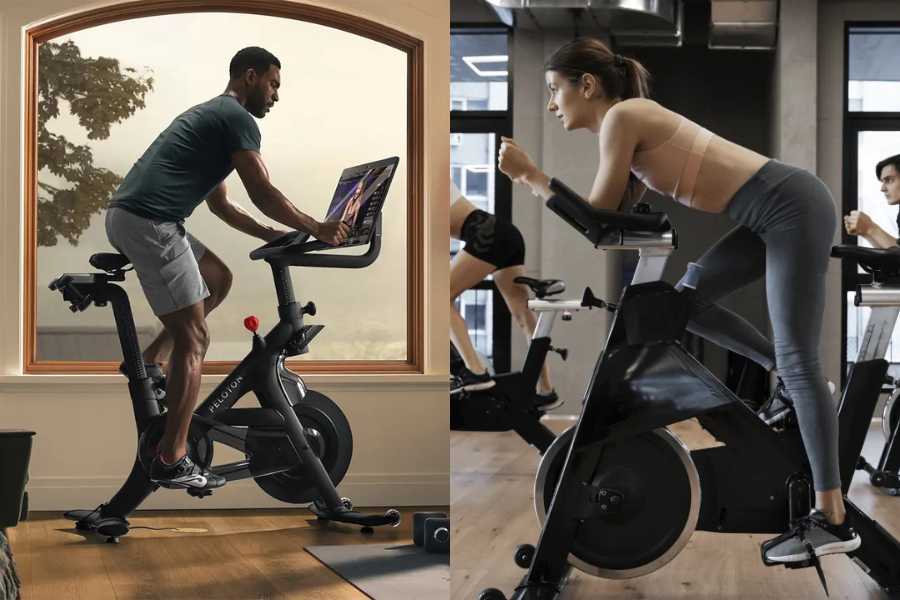
You can do the best exercise bike workouts on different types of bikes. Each style has its own strengths for comfort and muscle engagement.
According to Healthline, common indoor bike types include (Healthline):
- Upright bikes: These feel most like outdoor cycling. They strengthen your legs and core and are a good all around choice.
- Recumbent bikes: You sit in a reclined position with a larger seat and back support. This design is easier on your joints and lower back, which is helpful if you have pain or mobility issues.
- Dual action bikes: These have moving handlebars so you work your upper body and lower body at the same time for a full body workout.
Some higher end bikes also include incline and decline settings to simulate riding up and down hills, which can increase muscle engagement and add variety to your training (NordicTrack).
Choose the design that feels best to you. The bike that keeps you coming back is the one that will help you reach your weight loss and health goals.
Put it all together
You do not need a complicated plan to get motivated and see results from your exercise bike. Start with comfortable steady rides, learn how different effort levels feel, and then add in short HIIT sessions like 10 minute sprints, Tabata intervals, or the Peak 8 workout as your fitness improves.
Focus on consistency first, intensity second. Adjust resistance and duration gradually, keep your setup comfortable, and lean on music, apps, or classes if they help you enjoy the ride.
Pick one workout from this list and schedule it for your next session. After a few weeks of regular riding, you will likely notice more energy, better stamina, and a real shift toward your weight loss and health goals.
About the Author