A strong glute and hamstring workout does far more than sculpt your lower body. It supports your knees, hips, and back, improves athletic performance, and even makes everyday tasks like climbing stairs or picking up groceries feel easier. When you focus on smart exercise selection and good form, you can “feel the burn” in the right places instead of overloading your lower back or quads.
Below, you will learn how your glutes and hamstrings work, how often to train them, and get a complete beginner-friendly glute and hamstring workout you can start using this week.
Understand your glutes and hamstrings
Before you load up a barbell, it helps to know what you are actually training.
Your glutes are a group of three muscles: gluteus maximus, gluteus medius, and gluteus minimus. They originate from your pelvis (ilium and sacrum) and insert on your thigh bone (femur). Together they handle hip extension, abduction, and rotation, and they even assist with knee extension in some positions. The gluteus maximus is the largest and most powerful hip extensor, and it gives your butt most of its size and shape, which is why it is so important for jumping, sprinting, and explosive movements.
Your hamstrings run along the back of your thigh. They include the semitendinosus, semimembranosus, and the long and short heads of the biceps femoris. These muscles attach from your sit bones (ischium) down to your tibia and fibula. They control hip extension and knee flexion, so they help you walk, run, sit, stand, and decelerate your body when you sprint or jump. Strong hamstrings also support your back when you bend forward, like when you wash dishes or pick up a child.
When these muscles are strong and well coordinated, they stabilize your hips and knees and protect your lower back during daily life and workouts.
Key benefits of training glutes and hamstrings
A targeted glute and hamstring workout does a lot more than build muscle.
Stronger glutes and hamstrings help protect your knees and hips during everyday activities and sports. Since they act on both the hip and knee joints, they are essential for sprinting, jumping, and changing direction. Research in Current Sports Medicine Reports shows that strength based hamstring workouts reduce injury risk, especially in field athletes like football and soccer players, which underlines how valuable posterior chain training is for performance and durability.
There are broader health benefits too. Building muscle mass in your glutes and hamstrings through strength training can increase your metabolic rate, improve insulin sensitivity, support healthy blood pressure, and improve bone density and ligament strength. Nutrisense notes that this kind of training may also reduce injury risk, enhance your physical self concept, and potentially boost cognitive function and mental health in 2024 guidance. In other words, training your backside can have a positive impact on your entire body.
How often to do glute and hamstring workouts
Your training frequency should match your goals, schedule, and recovery.
Glute training expert Bret Contreras suggests that, for most people, training glutes around 3 times per week is a solid starting point, although effective programs can range from 2 to 6 days per week depending on genetics, exercise selection, volume, load, and effort. The optimal frequency for you depends heavily on how your full program is structured and how well you recover between sessions.
If you are newer to strength training, 2 glute and hamstring workouts per week is usually enough to see progress without feeling wiped out. As you advance, you might bump that to 3 weekly sessions, or you might use 2 focused days and sprinkle lighter posterior chain work into other workouts.
No matter your schedule, leave at least one rest or light movement day between heavy lower body sessions. This gives your glutes and hamstrings time to repair and grow.
Choose the best exercises for results
Not all lower body movements hit the glutes and hamstrings equally. Many popular “booty” moves overemphasize hip abduction, like endless side leg raises, and do not train the glutes in their main role, which is hip extension.
Fitness coach Jeremy Ethier highlights that a common reason people struggle to build bigger glutes is simply choosing the wrong exercises. The movements that emphasize hip extension are the ones you want to prioritize for glute growth and strength. That means exercises like squats, leg presses, Bulgarian split squats, deadlifts, and hip thrusts are your main players.
At the same time, it is easy to let other muscles take over. If you perform lower body exercises with poor form, your quadriceps often dominate and your glutes stay relatively quiet. Letting your lower back and hamstrings take over during “glute” exercises is another frequent mistake. The solution is to learn how each movement should feel, slow down your reps, and focus on controlled motion and tension in the target muscles rather than just chasing heavier weight.
Why squats alone are not enough
You might assume heavy squats are all you need to build powerful hamstrings, but that is not quite the case.
Barbell back squats are primarily quadriceps dominant. During a traditional squat, your hamstrings do not change length enough to receive a strong training stimulus. That means squat heavy and often if you like, but your hamstrings still need direct attention if your goal is strength, muscle growth, or injury prevention.
Squats and deadlifts are still foundational compound exercises for training the glutes and hamstrings together, and they are excellent for improving overall lower body strength and hypertrophy. Squats lean on more eccentric contractions, while deadlifts focus heavily on concentric effort. To train your posterior chain effectively, you want to complement squats with hip hinge based exercises like deadlifts, Romanian deadlifts, and hip thrusts.
Build your glute and hamstring workout
You do not need a complicated program to get strong glutes and hamstrings. What you do need is a mix of compound and isolation exercises, a focus on hip extension, and progressive overload.
A simple structure for a full glute and hamstring workout could be:
- Warm up and activation
- Main compound lifts
- Targeted accessory work
- Cool down and stretching
Here is how that can look in practice.
1. Warm up and activation
Spend about 10 minutes getting your heart rate up and your hips moving. Nutrisense recommends a warm up that includes cardio and dynamic movements like:
- 10 minutes of light cardio, such as brisk walking, cycling, or easy jogging
- Knee hugs
- Glute bridges
- Lunges with elbow to instep
- Standing hip flexions
This combination raises your body temperature and primes your glutes and hamstrings so you feel them working during heavier sets.
2. Main lifts for strength
Next, move into your big compound movements. These train multiple muscle groups at once and build a strong foundation.
You might choose 2 of the following for a given workout:
- Conventional deadlifts
- Back squats or leg presses
- Bulgarian split squats
- Hip thrusts
Deadlifts and their variations are especially valuable. The barbell deadlift is often highlighted as one of the best tools for hamstring growth because it lets you use heavy weights through a multi joint hip extension pattern. A common approach is 3 sets of 6 to 8 reps with a challenging but controlled load.
Romanian deadlifts (RDLs) are another key hip hinge that emphasizes the eccentric phase, where you lower the weight slowly with a soft knee bend. This variation isolates the posterior chain more by reducing knee movement, and 3 sets of 6 to 8 reps can effectively target your hamstrings while also helping your conventional deadlift.
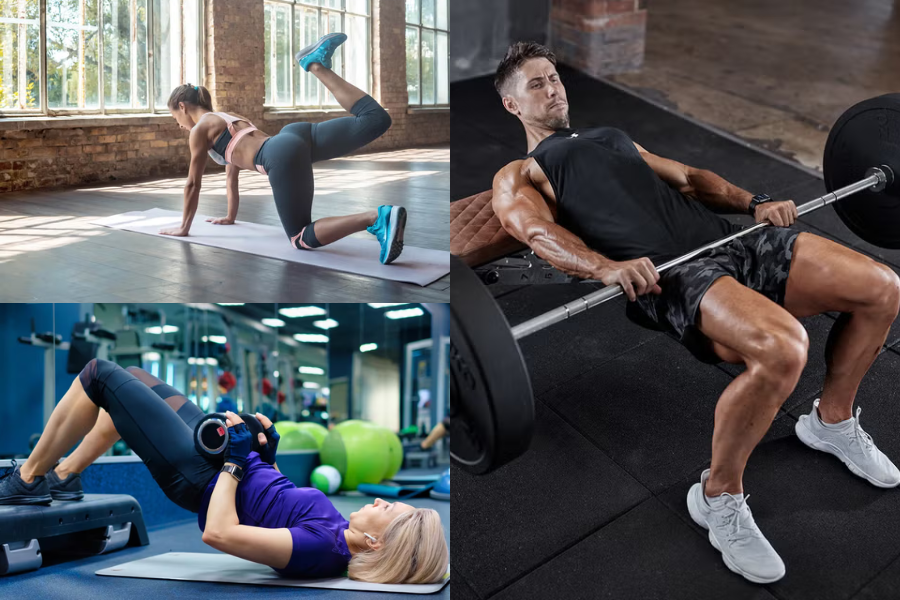
Hip thrusts focus heavily on the gluteus maximus. You rest your upper back on a bench, place a barbell or weight across your hips, and drive through your heels to thrust your hips upward. This movement improves hip extension strength and power and tends to be friendlier on the lower back than some other lifts, while still activating the hamstrings and adductors.
3. Accessory moves to feel the burn
After your main lifts, you can add a few targeted exercises that really make your glutes and hamstrings work hard through different ranges of motion.
Useful accessory exercises include:
- Hamstring curls (machine or stability ball)
- Single leg Romanian deadlifts
- Barbell or bodyweight glute bridges
- Kettlebell swings
- Donkey kicks or banded kickbacks
- Banded clamshells
Hamstring curls target the area closer to the back of your knee, since they focus on knee flexion. Bridges and hip thrust variations hit the portion of your hamstrings near the glutes and reinforce hip extension. Kettlebell swings give you a ballistic hip hinge that forces powerful hip extension, which can improve your power, athleticism, and metabolism. A common starting point is 3 sets of 12 to 15 swings, focusing on crisp hip snaps rather than squatting the weight.
To get both strength and muscle building benefits, you can use slightly lower reps with heavier weights for some accessories, such as 3 sets of 8 to 10 hip thrusts, and higher reps for others, such as 3 sets of 10 to 15 glute bridges or hamstring curls. The key is to maintain control, avoid using momentum, and feel the target muscles working through the entire movement.
Quick guideline: If you feel an exercise only in your lower back or quads, adjust your form before adding more weight. You want tension in your glutes and hamstrings first.
4. Cool down and stretch
Training hard is only half the equation. Flexibility work and recovery help keep your muscles healthy and resistant to strain.
For flexibility, it is helpful to include hamstring stretches 2 to 3 times per week. You might try:
- Standing hamstring stretch
- Seated forward bend
Hold each stretch for 15 to 30 seconds and stop before you feel pain. You want a strong but manageable stretch sensation, not a sharp pull. Start gently, especially if you are tight, and give yourself rest days so your muscles can recover and adapt between workouts.
Form tips to target the right muscles
The way you move matters more than how much weight is on the bar. To strengthen your glutes and hamstrings safely and effectively, focus on:
- Engaging your core to stabilize your torso
- Driving through your heels or midfoot during hip hinges and bridges
- Keeping your knees tracking in line with your toes
- Maintaining a neutral spine, not an exaggerated arch or rounding
To effectively strengthen your hamstrings, it is essential to perform exercises with proper form and deliberately engage your core and glutes. You want to feel your hamstrings doing the work. If your range of motion is limited at first, that is fine. Work within a safe range where you can feel the muscles activate and gradually increase depth as your flexibility and control improve.
For glute focused exercises, it often helps to think about squeezing your butt at the top of each rep. For hamstring focused lifts, pay attention to the stretch along the back of your thighs as you lower and the contraction as you return to the start.
Sample beginner glute and hamstring workout
Here is a beginner friendly routine, inspired by Nutrisense recommendations, that you can use 2 times per week. Rest 60 to 90 seconds between sets unless otherwise noted.
- Warm up
- 10 minutes light cardio
- 1 to 2 rounds of: knee hugs, glute bridges, lunges with elbow to instep, hip flexions
- Main lifts
- Conventional deadlift, 3 sets of 6 to 8 reps
- Dumbbell step ups or squats, 3 sets of 8 to 10 reps
- Accessories
- Hip thrusts, 3 sets of 8 to 10 reps
- Reverse lunges, 3 sets of 8 to 10 reps per leg
- Hamstring curls, 3 sets of 10 to 15 reps
- Cool down
- Standing hamstring stretch, 2 sets of 15 to 30 seconds per side
- Seated forward bend, 2 sets of 15 to 30 seconds
As you get stronger, you can increase the weight gradually, add sets, or swap in more advanced variations like single leg Romanian deadlifts or sumo deadlifts. Mixing isolation moves, such as banded clamshells, with heavy compound exercises like barbell hip thrusts and deadlifts helps you build strength, muscle, and control across your entire posterior chain.
Bringing it all together
An effective glute and hamstring workout is less about chasing novelty and more about consistently showing up for the basics. Focus on hip extension based exercises, combine compound and isolation work, and progress your loads over time. Pay attention to form so you feel the burn exactly where you want it, in your glutes and hamstrings, not in your lower back.
Start with one or two of the changes you have just read about, such as adding Romanian deadlifts or hip thrusts to your next leg day. As you notice your strength, balance, and confidence improving, you can keep layering in variety and volume to build the strong, resilient lower body you are after.
About the Author