A stronger lower body starts with your glutes. The best glute exercises do more than shape your backside. They support your hips and spine, help you lift heavier, run faster, and move with less pain in everyday life. If you spend a lot of time sitting, focusing on your glutes can be a game changer for how your whole body feels and performs.
Below, you will learn how your glutes work, the best glute exercises to include in your routine, and how to put them together into simple workouts that fit your schedule.
Understand your glute muscles
Before you load up a barbell or grab a resistance band, it helps to know what you are actually trying to train. Your glutes are a group of three muscles that work together in almost every step, squat, and hip movement you do.
The three parts of your glutes
-
Gluteus maximus
This is the largest and most powerful part of your glutes. It handles hip extension, like when you stand up from a squat or drive your hips forward during a hip thrust. It is a major player in sprinting, climbing stairs, and lifting anything off the ground. A 2019 guide from Gymshark highlights how crucial this muscle is for both aesthetics and athletic performance, as well as injury prevention. -
Gluteus medius
This muscle sits on the outer side of your hip. It helps with hip abduction, which is moving your leg out to the side, and it stabilizes your pelvis when you walk, run, or stand on one leg. A strong glute med keeps your knees from collapsing inward and supports your balance. -
Gluteus minimus
The smallest of the three, the glute minimus lies under the glute medius. It helps rotate your hip and keep your pelvis level. Along with the medius, it plays a key role in hip stability and healthy posture, as described in a Planet Fitness guide from July 2025.
When all three muscles are strong and active, you get better posture, improved athletic performance, and less risk of back, hip, and knee injuries.
Why glute strength matters
If your glutes are weak or underused, other muscles end up doing extra work. Over time that can show up as tight hip flexors, cranky knees, or a sore lower back. Long periods of sitting are one of the biggest reasons glutes become weak and inactive, which can hurt your mobility and increase your injury risk.
Strengthening your glutes can help you:
- Stand taller and feel more stable when you move
- Protect your knees and ankles by improving hip control
- Support your lower back during bending and lifting
- Generate more power for sports and workouts
Corrective glute exercises that focus on activation and balance can even help reduce ACL and knee injuries, hamstring strains, ankle sprains, and lower back problems by building stronger and more coordinated glute muscles.
Key principles for glute growth and strength
To get the most from the best glute exercises, it is not enough to just go through the motions. How you train matters.
Train often enough
For noticeable changes in strength and size, you want to train your glutes at least two to three times per week, with at least one day of rest between intense lower body sessions. That frequency gives your muscles enough stimulus to grow while still allowing time to recover.
Use the right rep ranges
If your goal is muscle size and strength, research-backed guidelines suggest you:
- Spend plenty of time in the 8 to 12 rep range using about 60 to 80 percent of your one rep max for hypertrophy focused work
- Include some heavier sets of 4 to 8 reps to build strength and recruit more muscle fibers
- Add lighter, higher rep sets of 12 to 15 reps to increase muscular endurance and metabolic stress
All of this should be done close to muscular failure while still maintaining good form.
Focus on quality, not just quantity
Glute training is not about endless sets of half squats. To make progress you need:
- Challenging but controlled weights
- Full range of motion whenever your joints allow it
- Strong mind muscle connection so you actually feel your glutes working
PureGym personal trainer Hannah Kerridge explains that building bigger glutes largely comes down to resistance training that creates tiny muscle tears your body repairs by building new muscle tissue over time. That repair process is what leads to visible muscle growth.
Best compound glute exercises
Compound movements work several muscle groups at once and should form the base of your glute training. They let you lift heavier, stimulate more muscle, and build strength that transfers directly into real life activities.
Squats and sumo squats
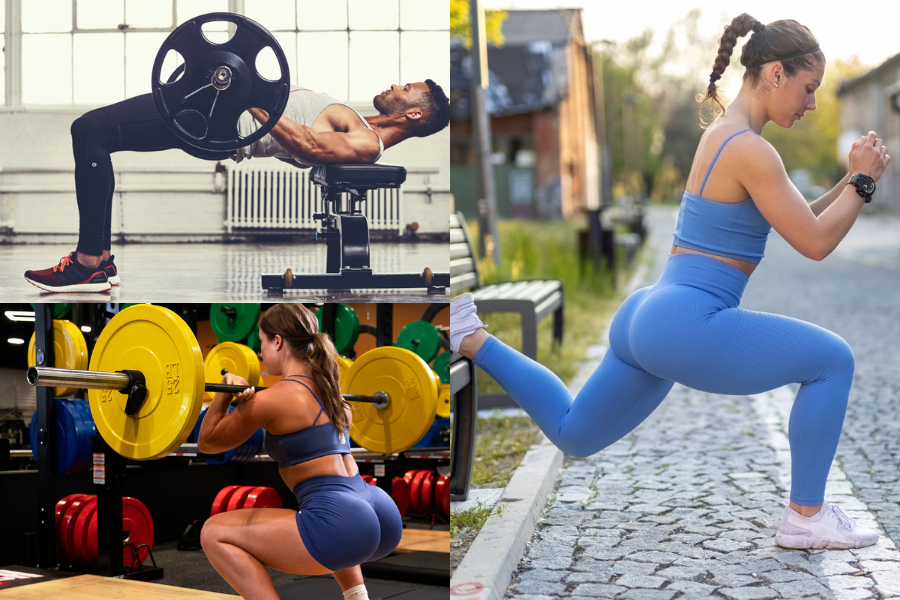
Squats are a classic for a reason. Traditional back squats hit your quads, hamstrings, and glutes. Sumo squats, with a wider stance and toes turned out, place extra emphasis on your glutes and inner thighs.
A 2017 study referenced by Gymshark found that back squats significantly increase glute engagement, especially when you work with heavier loads around 90 to 100 percent of your one rep max. A 2020 systematic review reported that squat variations can produce glute activation ranging from 13 to 92.7 percent of maximal voluntary isometric contraction, with wider stances and deeper squats generally increasing glute activity.
Start with bodyweight or goblet squats, then progress to barbell squats when your form is solid.
Romanian deadlifts
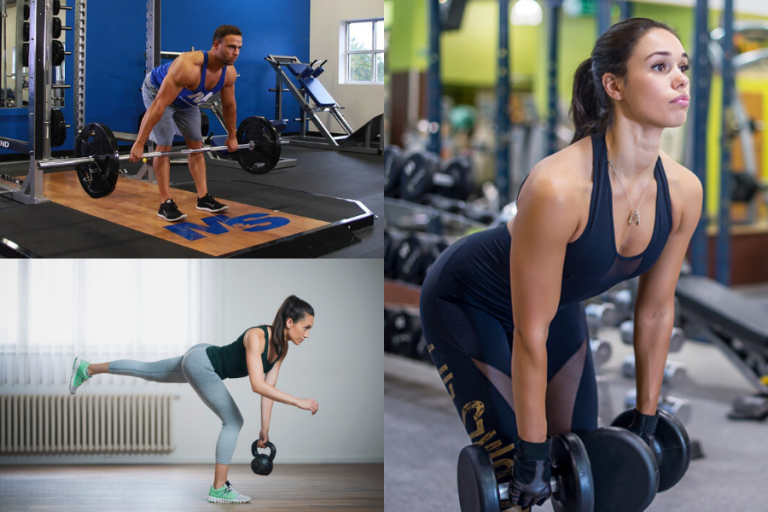
Romanian deadlifts, or RDLs, are one of the best glute and hamstring builders. You hinge at the hips with a slight bend in your knees and lower the weight while keeping your back flat, then drive through your heels to stand tall.
Because RDLs load the muscles in a stretched position, they are excellent for building strength and muscle mass in the gluteus maximus and hamstrings. A 2020 review also found that conventional and hex bar deadlifts produce very high glute activation levels above 60 percent of maximal contraction.
Bulgarian split squats
Bulgarian split squats are a favorite for single leg strength. You place your back foot on a bench or step, then lower your body by bending your front knee. This variation shifts more work to your front leg glute and quad, while also challenging your balance.
Gymshark notes that Bulgarian split squats are effective for unilateral glute training, improving single leg stability and helping to fix muscular imbalances, often with less strain on the knee compared with heavy back squats. Because they are so demanding, you can get a lot from them even with lighter weights.
Step ups and their variations
Step ups look simple but are extremely effective. You step onto a box or bench with one foot, drive through the heel, and lift your body up, then control the lowering back down. This move activates the gluteus maximus, medius, and minimus along with your hamstrings and quads.
Peloton experts recommend step ups as a top bodyweight exercise for glute activation, and a 2020 systematic review found that step up variations produced the highest levels of glute maximus activation, averaging 125 percent of maximal voluntary isometric contraction and reaching up to 169 percent when performed with external load.
Lateral, diagonal, and cross over step ups slightly change the angle of movement and challenge your glute medius and minimus in different ways.
Best isolation glute exercises
Isolation exercises let you zero in on your glutes and fine tune how each part of the muscle group is working. They are especially helpful when you have trouble feeling your glutes during bigger lifts.
Barbell and banded hip thrusts
If you are looking for one of the best glute exercises for pure glute growth, start here. In a hip thrust you rest your upper back on a bench, place a barbell or weight across your hips, and drive your hips up until your body forms a straight line from shoulders to knees.
Gymshark and ATHLEAN X both highlight the barbell hip thrust as one of the most effective moves for activating the gluteus maximus, often outperforming back squats and split squats for glute engagement. You can increase upper glute emphasis by using a slightly wider stance and adding a band around your knees to encourage more abduction.
A 2020 systematic review reported glute activation during barbell hip thrust variations ranging from about 49 to 105 percent of maximal voluntary contraction, with foot position and hip abduction angle playing a big role in how hard the glutes work.
If you do not have a barbell available, you can perform hip thrusts with dumbbells or a heavy resistance band instead. Peloton experts also recommend hip thrusts as one of the best lower body moves for recruiting multiple glute muscles.
Glute bridges and single leg variations
Glute bridges look similar to hip thrusts but are performed on the floor. You lie on your back with knees bent and feet flat, then squeeze your glutes to lift your hips. Bridges are particularly useful if you are a beginner or if you want to activate your glutes before heavier work.
Planet Fitness includes glute bridges and single leg glute bridges in their list of the best beginner glute exercises, noting that they help build strength, mobility, and stability across the glute complex. Wall supported single leg bridges can make the contraction even more intense by increasing tension at the top of the movement.
Kickbacks and banded variations
Glute kickbacks target hip extension and are especially good for the gluteus maximus. You can do them on a cable machine, with an ankle strap, or with a mini band around your legs.
Resistance band kickbacks are highlighted as a strong option for building larger glutes because they create constant tension and emphasize an aggressive hip extension, which is exactly what the glute max is meant to do. They are also joint friendly and easy to add at the end of a workout.
Clamshells and lateral band walks
To really dial in on the glute medius and minimus, side focused movements are your friend. Clamshells and lateral band walks use a resistance band around your legs and require you to push out against the band to move.
ISSA identifies clamshells, lateral band walks, and hip abductions as effective ways to target the glute medius and minimus, improve hip stability, and help prevent knee joint damage. Peloton also points out that banded lateral walks and clamshells are excellent for glute activation without needing heavy weights.
These exercises are great choices during your warm up or as “burn out” finishers at the end of a workout.
If you often feel your quads working more than your glutes, start every lower body session with 5 to 10 minutes of glute activation moves such as clamshells, band walks, and glute bridges. This can help “wake up” your glutes so they fire properly during squats and deadlifts.
Activation drills before heavy training
Glute activation drills are short, targeted movements that help you connect to your glute muscles before you move on to heavier or more complex exercises. This is especially important if your glutes tend to be weak, inactive, or overshadowed by your quads and lower back.
Peloton instructors and physical therapists recommend adding glute activation before running, cycling, strength sessions, or HIIT workouts to boost performance and reduce injury risk.
Helpful activation choices include:
- Toe down hip lifts and stability ball hip drops and lifts
- Bodyweight glute bridges or frog pumps
- Resistance band lateral walks and clamshells
- Step ups and single leg glute bridges
These should feel challenging but not exhausting. Think of them as priming the muscle, not replacing your main work.
Simple glute workout ideas
You do not need a complicated program to benefit from the best glute exercises. Start with a couple of compound movements, add one or two isolation exercises, and finish with activation or corrective work if you have time.
Beginner glute workout (2 days per week)
Day 1
- Bodyweight squats, 3 sets of 10 to 12 reps
- Glute bridges, 3 sets of 10 to 12 reps
- Step ups, 3 sets of 8 to 10 reps per leg
- Clamshells with or without a band, 2 sets of 12 to 15 reps per side
Day 2
- Romanian deadlifts with dumbbells, 3 sets of 8 to 10 reps
- Reverse lunges, 3 sets of 8 to 10 reps per leg
- Single leg glute bridges, 3 sets of 8 to 10 reps per leg
- Lateral band walks, 2 sets of 10 to 12 steps each direction
These exercises mirror many of the 12 beginner friendly glute moves outlined by Planet Fitness, including squats, lunges, step ups, clamshells, and glute bridges.
Intermediate glute workout (3 days per week)
Day 1, Strength focus
- Back squats, 4 sets of 4 to 6 reps
- Barbell hip thrusts, 4 sets of 6 to 8 reps
- Lateral band walks, 3 sets of 10 steps each way
Day 2, Unilateral focus
- Bulgarian split squats, 3 sets of 8 to 10 reps per leg
- Single leg Romanian deadlifts, 3 sets of 8 to 10 reps per leg
- Glute kickbacks, 3 sets of 12 to 15 reps per leg
Day 3, Hypertrophy and activation
- Sumo squats, 3 sets of 10 to 12 reps
- Dumbbell or banded hip thrusts, 3 sets of 10 to 12 reps
- Clamshells or side plank hip abductions, 2 to 3 sets of 12 to 15 reps
Aim to add a small amount of weight, an extra rep, or an extra set over time to apply progressive overload. Planet Fitness also suggests working with a fitness professional if you want more guidance on load, form, and progression, especially as your workouts become more demanding.
Putting it all together
You do not have to overhaul your entire routine to benefit from the best glute exercises. Start by:
- Picking one or two compound lifts like squats, deadlifts, or step ups
- Adding a hip thrust or glute bridge variation
- Finishing with a targeted isolation move for the side or upper glutes
Train two to three times a week, pay attention to form, and be patient with your progress. With consistent effort and smart exercise choices, you will not just build stronger glutes, you will support your whole body in moving better, feeling more stable, and staying active for the long term.
About the Author