A smart bicep workout routine does more than chase a short-lived pump. When you understand how your biceps work, how often to train them, and which exercises to prioritize, you can build stronger, fuller arms without wasting time.
Below, you will learn how your biceps function, how to design an effective routine, and how to avoid the mistakes that stall progress.
Understand your bicep anatomy
You do not need a degree in anatomy, but a basic grasp of the muscles in your upper arm will help you pick better exercises.
The main player is the biceps brachii, the familiar two-headed muscle on the front of your upper arm. It has a long head, which helps create the peak when you flex, and a short head, which adds thickness and width. Both heads flex your elbow and assist with rotating your forearm so your palm turns upward.
Supporting the biceps are two key muscles:
- The brachialis, which sits beneath the biceps and is responsible for a large portion of elbow flexion strength.
- The brachioradialis, a thick muscle running along the forearm that adds size and shape to your lower arm.
Training all three, not just the biceps brachii, is important if you want your arms to look big from every angle. The brachialis is roughly 50 percent stronger than the biceps and contributes a lot to your overall arm pump, so ignoring it limits your growth potential.
Set clear goals for your routine
Before building a bicep workout routine, decide what you actually want:
- More size and fullness
- More strength for pulling exercises like chin ups and rows
- Better symmetry between left and right arms
- General toning and definition
If your main goal is size, you will want to emphasize hypertrophy-focused rep ranges, progressive overload, and training your biceps multiple times per week. For strength and performance, you will still use many of the same exercises, but you might slightly lower the rep range and pay extra attention to heavier loads and technique.
You can blend these goals, but having a primary focus keeps your training structured and easier to track.
Choose the best bicep exercises
Most effective bicep workouts revolve around curl variations. Any curl that lets you flex and then slowly extend your elbow, while keeping tension on the biceps, can build muscle size and strength.
Fundamental mass builders
These exercises form the backbone of a solid bicep workout routine:
-
Dumbbell curls
Standing or seated, dumbbell curls let you train each arm individually. This improves symmetry and allows a natural wrist path, which can feel better on your joints. -
Barbell curls
Using an Olympic bar or EZ bar, barbell curls let you move heavier weights and overload both heads of the biceps. To avoid turning it into a back exercise, keep your torso tall and reduce body swing. -
EZ bar curls
The angled grip of an EZ bar changes how your wrists sit and can reduce strain. A closer grip tends to emphasize the long head, while a wider grip tends to shift slightly more to the short head.
Exercises targeting specific heads
To shape your biceps from different angles, mix in exercises that bias each head.
For the long head and peak:
-
Hammer curls
Hold the dumbbells with a neutral grip, like holding a hammer. Hammer curls shift more work to the long head of the biceps and the brachioradialis, which builds upper arm and forearm thickness. -
Incline dumbbell curls
When your arms hang behind your torso on an incline bench, the long head is placed on a deep stretch, which is great for growth.
For the short head and thickness:
-
Preacher curls
Using a preacher bench or an incline bench set up as a support, you curl with your upper arm fixed in front of your body. This position puts more emphasis on the short head. -
Concentration curls
Performed sitting with your elbow braced against your inner thigh, concentration curls isolate the short head and help you really focus on the mind muscle connection. Lighter weights with strict form work well here. -
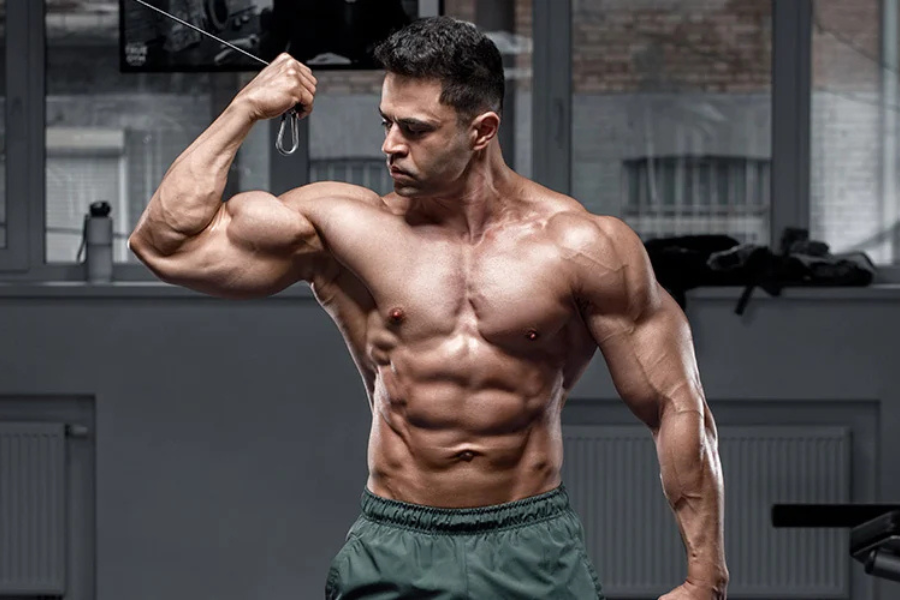
Single arm high cable curls
Standing side on to a cable stack with the cable set high, you curl your hand toward your ear. This keeps constant tension on the short head and is great as a finisher.
Compound and bodyweight options
Chin ups, performed with an underhand or narrow grip, allow you to train the biceps heavily while also working your back. Depending on your grip width and angle, both the long and short heads are involved, so chin ups pair nicely with curl variations in a complete routine.
Build a balanced bicep workout routine
Once you know your exercise choices, you need a structure. Volume, frequency, and rep ranges are where your results really come from.
Ideal sets, reps, and frequency
For hypertrophy, research supports working in the 8 to 12 rep range for 3 to 4 sets per exercise, using a weight that challenges you while still allowing good form. Across a week, aim for roughly 2 to 4 quality bicep exercises per session, often paired with back or upper body training.
Training your biceps 2 to 3 times per week is more effective for muscle growth than hitting them once a week. Data suggests this higher frequency can produce around 3.1 percent greater weekly hypertrophy compared with a single weekly session, provided you recover properly.
More is not always better. Training your biceps every day, especially with high intensity, can lead to fatigue, stalled progress, and a higher risk of overuse injuries. Micro tears in the muscle fibers need time to repair and grow, so your rest days are when the real growth happens, not in the gym.
Sample beginner bicep workout
If you are newer to resistance training, 1 to 2 focused bicep sessions per week is enough. Here is a simple structure inspired by popular beginner frameworks:
-
Warm up, about 5 minutes
Light banded chin ups, rotational dumbbell curls with very light weight, an inverted plank, and a gentle behind the back bicep stretch will mobilize your shoulders and elbows without tiring your muscles out. -
Seated dumbbell curls
3 sets of 10 to 12 reps
Sit tall, keep your upper arms still, and slowly lower each rep. Focus on strict form instead of heavy weight. -
Standing barbell or EZ bar curls
3 sets of 8 to 10 reps
Choose a weight that feels challenging on the last 2 reps, but avoid swinging your torso. Keep your elbows close to your sides. -
Single arm preacher curls
2 to 3 sets of 10 to 12 reps each arm
Use an incline bench if needed, and let your arm extend fully at the bottom before curling back up.
Rest 60 to 90 seconds between sets. For beginners, this is plenty of work when done with focus and control.
Example routine for intermediate lifters
If you already lift regularly and want more arm size, try training biceps 2 to 3 times a week, paired with back or push days. A typical session might look like this:
- Hammer curls: 3 sets of 8 to 10 reps
- EZ bar curls: 3 sets of 8 to 12 reps
- Preacher curls: 3 sets of 10 to 12 reps
- Single arm high cable curls or concentration curls: 2 to 3 sets of 10 to 15 reps
This combination hits the long head, short head, brachialis, and brachioradialis, and it balances heavy work with more focused isolation.
Quick guideline: pick 2 to 4 bicep exercises per session, train mostly in the 8 to 12 rep range for 3 to 4 sets, and repeat that 2 to 3 times per week for steady growth.
Use progressive overload the right way
Your muscles adapt. If you keep doing the same weight for the same reps, progress will slow. Progressive overload is the simple idea of gradually asking your muscles to do more so they keep growing.
You can apply it in several ways:
- Add a small amount of weight to your curls while staying in the 8 to 12 rep range.
- Add an extra set for one exercise once the current volume feels easy.
- Improve your tempo by slowing the lowering phase to 3 or 4 seconds per rep.
- Reduce rest times slightly to increase the challenge.
Avoid changing everything at once. Pick one variable to progress at a time so you can track your response and avoid overload. The goal is to challenge your biceps, not punish your joints.
Varying your exercises over time also helps. Muscles become efficient and stop growing if they get the exact same routine for too long. Occasionally starting your session with a different exercise, or pre tiring smaller muscles like the brachialis with hammer curls before traditional curls, can increase overall muscle recruitment and long term gains.
Fixing bicep imbalances
It is common for one arm to be slightly larger or stronger than the other. You can reduce this imbalance by being intentional in your bicep workout routine.
Emphasize unilateral exercises like single arm dumbbell curls, concentration curls, and single arm preacher curls. For the smaller arm, you can add one extra set at the end of each exercise or one extra short session per week that focuses just on that side.
Make sure you use the same weight for both arms, chosen based on what the weaker side can handle with good form. Avoid letting the stronger side dictate the load, or the imbalance will persist.
Avoid common bicep training mistakes
Good exercises can still deliver poor results if your form and habits are off. Several mistakes show up again and again in bicep training and they are all fixable.
Rushing your reps
Curling too fast relies on momentum instead of muscle. Slowing your tempo, especially during the lowering phase, increases time under tension. Some coaches recommend taking up to four seconds both on the way up and on the way down for focused sets, which really forces the biceps to work through the full range of motion.
Using your shoulders and back
If your elbows swing forward and your torso leans back, your shoulders and lower back are stealing the work. To correct this, keep your elbows fixed by your sides, stand tall with a tight core, and avoid any excessive lean. Reset your stance and breath between reps if needed.
Cutting the range of motion
Half curls give you half the benefit. Lower the weight until your arms are fully extended but not locked out painfully, then curl until your biceps are fully contracted. Cheating with partial reps can be useful as an advanced overload technique, especially if you control the negative, but beginners should master strict full range first.
Mixing curl patterns mid rep
Twisting your wrist halfway between a hammer curl and a standard curl lets you skip the hardest part of the movement. Instead, keep a consistent hand position during the lift and, if you want to add supination, twist only at the top after you have already curled the weight up. This keeps tension where you want it, on the biceps, for the full rep.
Prioritize recovery for growth
Every effective bicep workout routine is built on recovery. When you lift, you create micro tears in the muscle fibers. When you rest, your body repairs these fibers so they grow thicker and stronger.
If you train your biceps too often without recovery, those micro tears do not have time to heal. Over time, you will feel more fatigue, your strength will plateau, and nagging aches might appear. That is why training biceps every day is not recommended for most people. Hitting them 2 to 3 times per week with effort and then allowing rest will lead to better progress.
Sleep, nutrition, and general stress management all play a role. Aim for enough protein to support muscle repair, stay hydrated, and try to get consistent, quality sleep so your body can do the behind the scenes rebuilding work.
Putting it all together
Creating an effective bicep workout routine is less about chasing the newest exercise and more about getting the basics right, then repeating them consistently:
- Train both heads of the biceps, plus the brachialis and brachioradialis, for full arm development.
- Center your training around curl variations, spreading 2 to 4 exercises over 2 to 3 weekly sessions.
- Work mainly in the 8 to 12 rep range for 3 to 4 sets, and apply progressive overload over time.
- Fix imbalances with unilateral work and slightly higher volume for your weaker side.
- Avoid rushing reps, swinging your torso, or cutting the range of motion.
- Respect recovery so the muscle can actually grow between workouts.
Start by choosing one beginner or intermediate template and follow it for 8 to 12 weeks, tracking your loads, reps, and how your arms feel. Small, steady improvements session by session will deliver the bigger, stronger biceps you are working for.
About the Author